
-2-1.png)

Occupational health is more important than ever. As our world continues to accelerate, researchers are emphasizing the looming danger of burnout, calling it “one of the most psychosocial hazards” for professionals.
Everybody knows the hallmarks of burnout: Lack of ambition, self-efficacy, or enthusiasm. But, for business leaders in particular, these executive burnout symptoms can also be characteristic of a broader feeling of being stuck in a rut. So, how do you discern between executive burnout and feeling stuck? More importantly, what can you do about it?
What Is Executive Burnout?
Executive burnout can be characterized as a combination of chronic work-related stress and emotional exhaustion. Unlike a rut, which one may incidentally “fall into” and, just as easily, escape from, burnout is persistent and oppressive.

The “executive” label sharpens things further - research indicates that managers face unique challenges from the workers they employ; big-picture problems like growth and direction of the company, hiring and firing decisions, and more. Executive burnout can even manifest physically, leading to fatigue or lethargy. Basically, sufferers of executive burnout have lost their mojo.
What It Means to Feel “Stuck”
Many of the feelings associated with executive burnout are also present in those who simply feel stuck in life. It’s hard to put one foot in front of the other when you don’t have a destination in mind, even if you’re a confident, capable individual.
Some scholars have described this feeling as a career plateau - a subjective state that harms workplace capability and diminishes drive.
Where Executive Burnout & Feeling Stuck Overlap
Being burnt out and feeling stuck are more similar than different. Both tend to include feelings of dissatisfaction or a reservoir of motivation that has run dry. But if you’re seeking solutions to combat your apathy, it pays to be precise about the cause.

In either case, the practical impact of feeling stuck or experiencing executive burnout is clear: You perform worse at work, which makes you feel worse about the work itself. Before you know it, you’re trapped in a negative loop.
Key Differences Between Burnout and Feeling Stuck
However, executive burnout and feelings of being stuck are not uniform. Their “symptoms” may frequently overlap, but one key area where they differ is origin:
- Executive burnout often arises as a consequence of overwhelming, complex, or abstract challenges without clear solutions.
- Feeling stuck builds gradually and is often of one’s own making, even if external circumstances aren’t necessarily stressful.
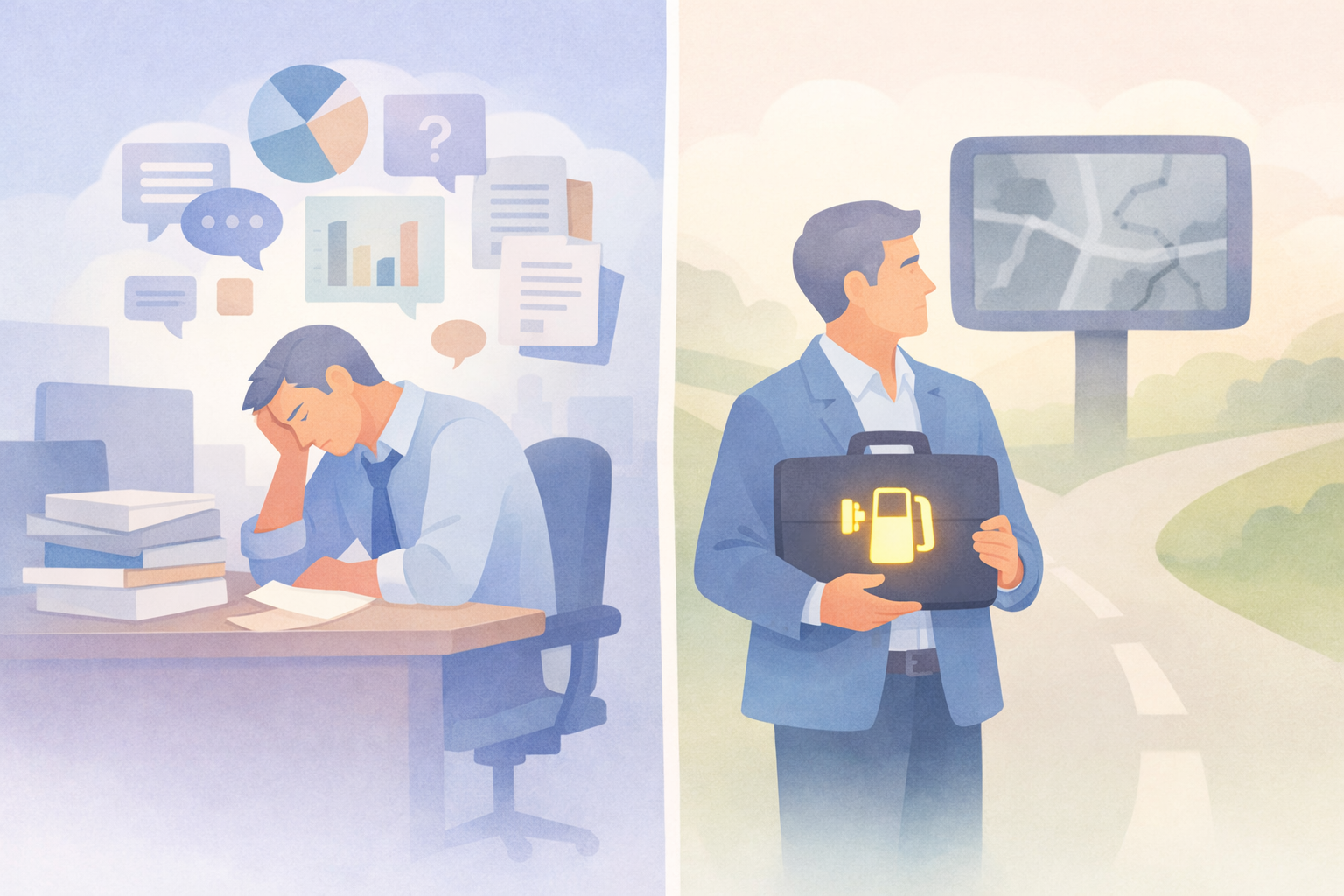
If executive burnout is an empty gas tank, feeling stuck is having a full tank of gas and a broken GPS. All the fuel in the world is worthless if you don’t know where you’re trying to go.

This distinction matters because it informs how you’ll tackle your troubles. Executive burnout may require a substantial intervention to overcome, while you may be able to get yourself unstuck with a gentle nudge. Burnout is something that needs healing; feeling stuck may just need a pivot
What To Do Next
For Burnout
If you believe you’re suffering from executive burnout, the first thing you should consider is taking a step back. A flame that has fizzled to embers still emits heat, but can’t light up a room. For business leaders, deliberately hitting the brakes can feel counterintuitive, but it may be necessary.
Executive burnout symptoms tend to flare up around specific triggers: a complex problem at work, a testy professional relationship, or a daunting deadline. Those issues are tricky to tackle, especially if you’re deep in the throes of burnout. Working with a mental health professional can help create healthy distance.

Once you distance yourself from the aspects of your job that are burning you out, you can come up with an action plan to build back better without falling into the same cycle all over again. Studies tell us that “mindfulness-based interventions” - think journaling, meditation, yoga, exercise, or therapy - can meaningfully reduce feelings of emotional exhaustion.
To Get Unstuck
If you need to dislodge yourself from a career rut, taking a step back may not be the right move - it’s possible that you just need to change your perspective. A curious mindset can help you consider career moves you’ve previously overlooked; taking on new projects sharpens your skill set, boosting your confidence and self-efficacy.
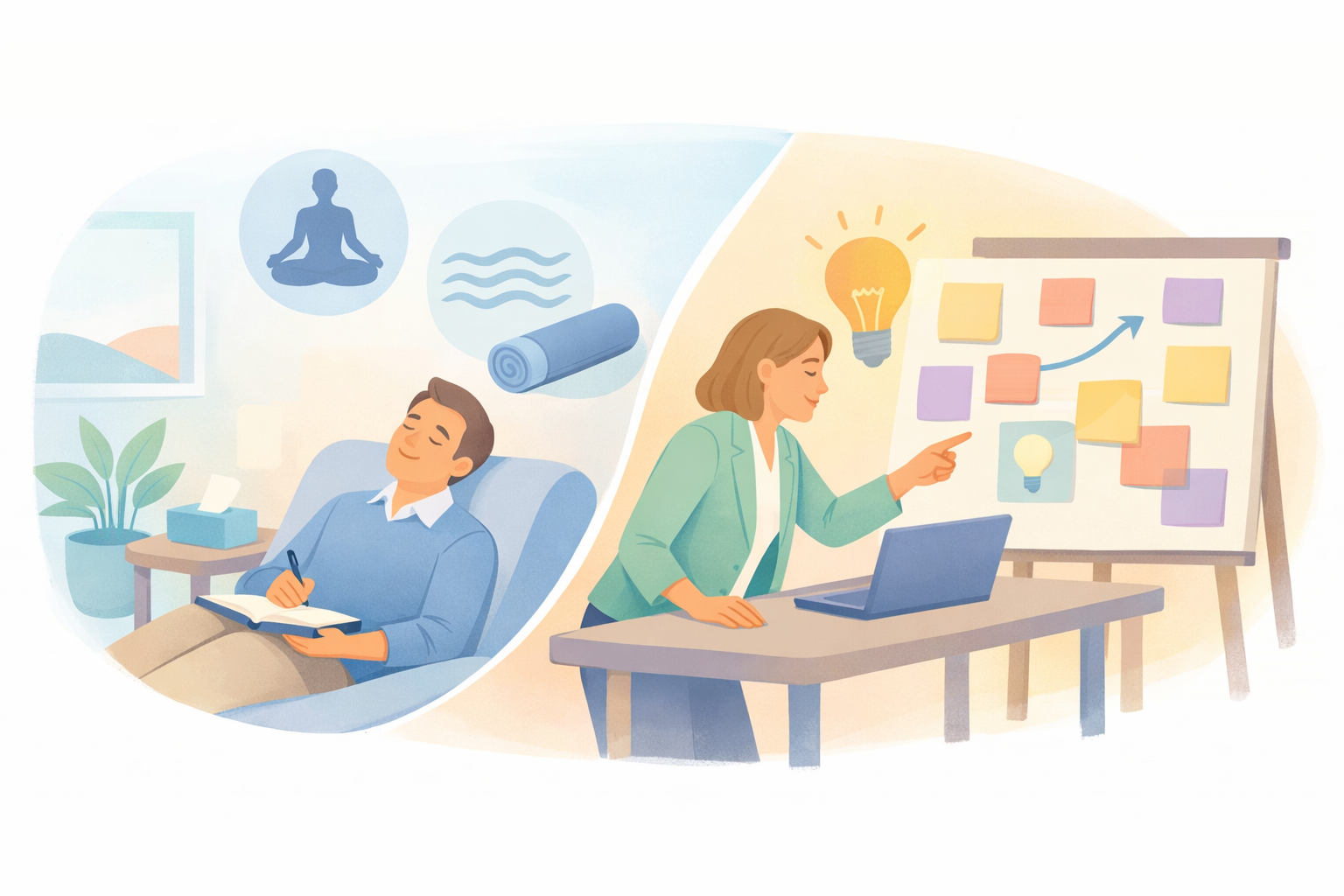
Beating burnout requires drastic action, but you may be able to escape a stuck feeling by making a series of small changes and seeing where things lead.
Executive Burnout & Feeling Stuck: The Role of Psychedelics
Overcoming burnout or clawing your way out of a rut is easier said than done. Psychedelics hold promise as an expansive intervention for the cynical and close-minded. Psychedelics like psilocybin target neural rigidity; clinical trials show us that psychedelic therapies can combat depression, reignite motivation, and make people more creative.

These effects - all of which are still under rigorous testing and review by the scientific community - are the backbone of psychedelic retreats. Retreats use cultural wisdom, and take inspiration from emerging science, to scaffold the psychedelic experience. Over the course of a few days to a week, guests at legitimate retreats…
- Undergo rigorous health and compatibility screenings
- Thoroughly map out goals and intentions
- Consume psychedelics under expert supervision
- Integrate the experience into their broader lives through targeted exercises
Beckley Retreats has extensive experience serving the needs of the business class. Since launching in 2021, co-founder Neil Markey has remarked that 60% of Beckley guests report some form of burnout: “Our programs offer an opportunity to reset, learn new habits, and find relief.”
Frequently Asked Questions
Sources
- Edú-Valsania S, Laguía A, Moriano JA. Burnout: A Review of Theory and Measurement. Int J Environ Res Public Health. 2022 Feb 4;19(3):1780. doi: 10.3390/ijerph19031780. PMID: 35162802; PMCID: PMC8834764.
- Müller, M., & Kubátová, J. (2026). A systematic review of managerial burnout and personal crisis: Navigating the interplay of individual, organizational, and environmental factors. German Journal of Human Resource Management: Zeitschrift Für Personalforschung, 40(1), 15-55.
- Ng, K., & Yang, W.-N. (2024). Feeling stuck and feeling bad: Career plateaus, negative emotions, and counterproductive work behaviors. Human Resource Management Journal, 34(4), 921–941.
- Dou J, Lian Y, Lin L, Asmuri SNB, Wang P, Rajen Durai RA. Effectiveness of mindfulness-based interventions on burnout, resilience and sleep quality among nurses: a systematic review and meta-analysis of randomized controlled trials. BMC Nurs. 2025 Jul 1;24(1):739. doi: 10.1186/s12912-025-03101-0. PMID: 40598019; PMCID: PMC12210539.
- Carhart-Harris RL, Bolstridge M, Day CMJ, Rucker J, Watts R, Erritzoe DE, Kaelen M, Giribaldi B, Bloomfield M, Pilling S, Rickard JA, Forbes B, Feilding A, Taylor D, Curran HV, Nutt DJ. Psilocybin with psychological support for treatment-resistant depression: six-month follow-up. Psychopharmacology (Berl). 2018 Feb;235(2):399-408. doi: 10.1007/s00213-017-4771-x. Epub 2017 Nov 8. PMID: 29119217; PMCID: PMC5813086.
- Roberts BF, Zylko AL, Waters CE, Crowder JD, Gibbons WJ Jr, Sen AK, Jones JA, McMurray MS. Effect of psilocybin on decision-making and motivation in the healthy rat. Behav Brain Res. 2023 Feb 25;440:114262. doi: 10.1016/j.bbr.2022.114262. Epub 2022 Dec 15. PMID: 36529299.
- Luisa Prochazkova, Josephine Marschall, Michiel van Elk, Ben D. Rifkin, Neil R. Schon, Donatella Fiacchino, George Fejer, Martin Kuchar, Bernhard Hommel, Microdosing psilocybin and its effect on creativity: Lessons learned from three double-blind placebo controlled longitudinal trials, Neuropharmacology, Volume 284, 2026, 110732, ISSN 0028-3908
Before you apply
Beckley runs legal, guided psilocybin retreats in Jamaica and psilocybin retreats in the Netherlands: four weeks of preparation, two guided sessions on retreat, six weeks of integration, online and at your own pace, one to two hours a week. Plain answers to the questions people ask first:
What a psilocybin retreat costs · What happens, day by day · Jamaica or the Netherlands · Who should not attend · Apply