
-2-1.png)



Psilocybin, the psychoactive compound found in various mushroom species, continues to gain prominence for its potential as a therapeutic agent and a catalyst for personal growth, with a unique ability to help people experiment with consciousness. As more studies are conducted and individual cities open their mind to psilocybin’s potential benefits, the public is becoming more open-minded to the possibilities mushrooms have to offer.
Known depictions of mushrooms date back to 1000 BCE, with depictions of psychedelic use first noted between 6000 and 4500 BC in what is now Algeria. With more than 200 species of psychedelic mushrooms, Psilocybe azurescens has one of the highest concentrations of this psychedelic alkaloid found across the fungal kingdom. This makes it an interesting mushroom to learn about and understand.
What This Mushroom Is Known For
Psilocybe azurescens is commonly known as a heavy hitter due to its status as one of the most potent species. Lab analyses have documented psilocybin concentrations reaching roughly three times what you'd find in Golden Teacher, one of the most widely available and commonly consumed types of mushrooms.

P. azurescens is almost purely endemic to the Pacific Northwest coast along the coastal dune ecosystems. This geographic limitation, combined with high potency, has made it notable in psilocybin research and among cultivators attempting outdoor growing in suitable climates. While difficult to execute, successful cultivations have been achieved across the globe in Germany, the Netherlands, New Zealand, the UK, California, New Mexico, Ohio, Oregon, Washington, Vermont, Wisconsin, and Pennsylvania, so it isn’t impossible.
Quick Facts:
|
Species |
Psilocybe azurescens |
|
Common Names |
Flying Saucer, Blue Angel, Azzies |
|
General Potency Category |
Very High |
|
Notable Traits |
Highest known psilocybin concentrations among naturally occurring Psilocybe species |
How It Compares to Golden Teacher
Golden Teacher is considered to have moderate-strength, reliable cultivation, and (mostly) predictable effects - making it a solid baseline to compare against other species. On the other hand, P. azurescens is considered among the more potent psilocybin mushroom species known, with analyses by Stamets and Gartz reporting substantially higher levels of psilocybin compared to P. cubensis, but also notably elevated baeocystin (.35 percent) - a secondary trypatime present only in trace amounts of P. cubensis, if at all, and one whose potential contribution to overall experience remains poorly understood.
Anecdotal accounts suggest that P. azurescens is widely held in high regard among those who have experienced it, and many report it as distinct from P. cubensis in character. Reports come from a range of individuals, and while accounts naturally vary, there are some consistent themes that emerge.

People frequently describe their experience as particularly visual and fast-paced, with a bright, outward-facing quality that some find distinct from the more introspective nature of other comparable mushrooms. A number of accounts also reference a notable physical dimension, sometimes described as an electrical or energetic body sensation, and report it’s easier on the system, potentially because the necessary quantity is smaller given its higher potency.
These are anecdotal observations and should be taken as such. That said, the consistency across independent accounts makes these reports noteworthy. Broadly speaking, P. azurescens appears to be highly regarded as potent, visually rich, and a species many would describe as uplifting and extrospective.
Cultivation techniques also create a clear distinction among fungal species. Golden Teacher grows on sterilized grain indoors with minimal equipment. P. azurescens requires wood chip substrates, outdoor beds, and specific conditions that make indoor home cultivation less practical.
Reported Effects & Experience
Scientific literature on subjective effects remains minimal, with hopes that more studies will be conducted as we learn more about the benefits of using psychedelics. What follows draws from limited clinical extrapolation from psilocybin studies and anecdotal community reports.
Mental effects are best based on documented psilocybin content; effects are expected to follow patterns observed in clinical research with pure psilocybin, such as altered perception, changes in mood and cognition, and, at higher (hero) doses, ego dissolution and mystical-type experiences.

Physical effects documented in psilocybin research include pupil dilation, changes in body temperature regulation, occasional nausea during onset, and increased heart rate. The distinguishing feature specific to P. azurescens and related wood-loving species is wood lover's paralysis - a scary yet rare occurrence. Documented symptoms from a 2025 study include muscle weakness in extremities, difficulty with motor control, and, in roughly one-fifth of affected individuals, falls or accidents.
It’s debatable whether intensity differences stem purely from psilocybin concentration or involve other alkaloids remains uncertain. P. azurescens is distinguished from P. cubensis in part by its elevated baeocystin content (.35 percent per Stamets and Gartz), though current evidence suggests baeocystin is unlikely to modulate effects, as it appears unable to reliably cross the blood-brain barrier, and our understanding of how these secondary tryptamines influence experience remains in its infancy. Set, setting, and individual neurochemistry are still important factors.
Potency Information: What We Know (and Don't)
Potency data comes from limited samples, primarily from Stamets and Gartz's 1995 description and subsequent mycological analyses of Pacific Northwest specimens. A 2024 genomics study reported concentrations up to 17.8 mg/g (1.78 percent), noting that P. azurescens is difficult to produce in a laboratory setting and may not reflect the mushrooms that grow outdoors, as UV rays from sunlight may degrade alkaloids, and therefore, diminish potency.
Cultivation conditions, such as substrate composition, humidity, temperature, and harvest timing, all affect alkaloid content. Within-species variation complicates dosing because two mushrooms from the same flush may have different concentrations. Genetic surveys reveal diversity in the psilocybin biosynthetic gene cluster, suggesting that genetically similar specimens may produce different ratios of compounds.

Potency comparisons between species are, at best, imperfect until more research is conducted. Lab conditions vary, sample sizes are generally small, and most published data come from mycology journals. The 1.8 percent figure is reliable for practical purposes in clinical settings, since this mushroom contains substantially more psilocybin than P. cubensis, but it is not precise and represents the current best understanding. As little as one gram or even a few dried mushrooms could be a potent dose.
Origins & Classification
Psilocybe azurescens was formally described in 1995 by mycologist Paul Stamets and chemist Jochen Gartz in Integration: Journal for Mind Moving Plants and Culture. The species name refers to the distinctive blue ("azure") bruising caused by psilocin oxidation.
Taxonomy:
- Family: Hymenogastraceae
- Order: Agaricales
- Section: Subaeruginosae
Though the discovery story remains elusive, it has been credited to a Boy Scouts camping trip near the Columbia River in Oregon around 1979. Stamets collected specimens from Hammond, Oregon, that revealed exceptionally high alkaloid concentrations, prompting a formal report.
Where It Grows Naturally
Psilocybe azurescens' native range is coastal areas of Oregon, Washington and California of the USA, and British Columbia in Canada. According to the latest information, it is considered endemic to this area, making it a rare species. Though, because it has a small natural range, some speculate that this species is introduced to certain new areas.
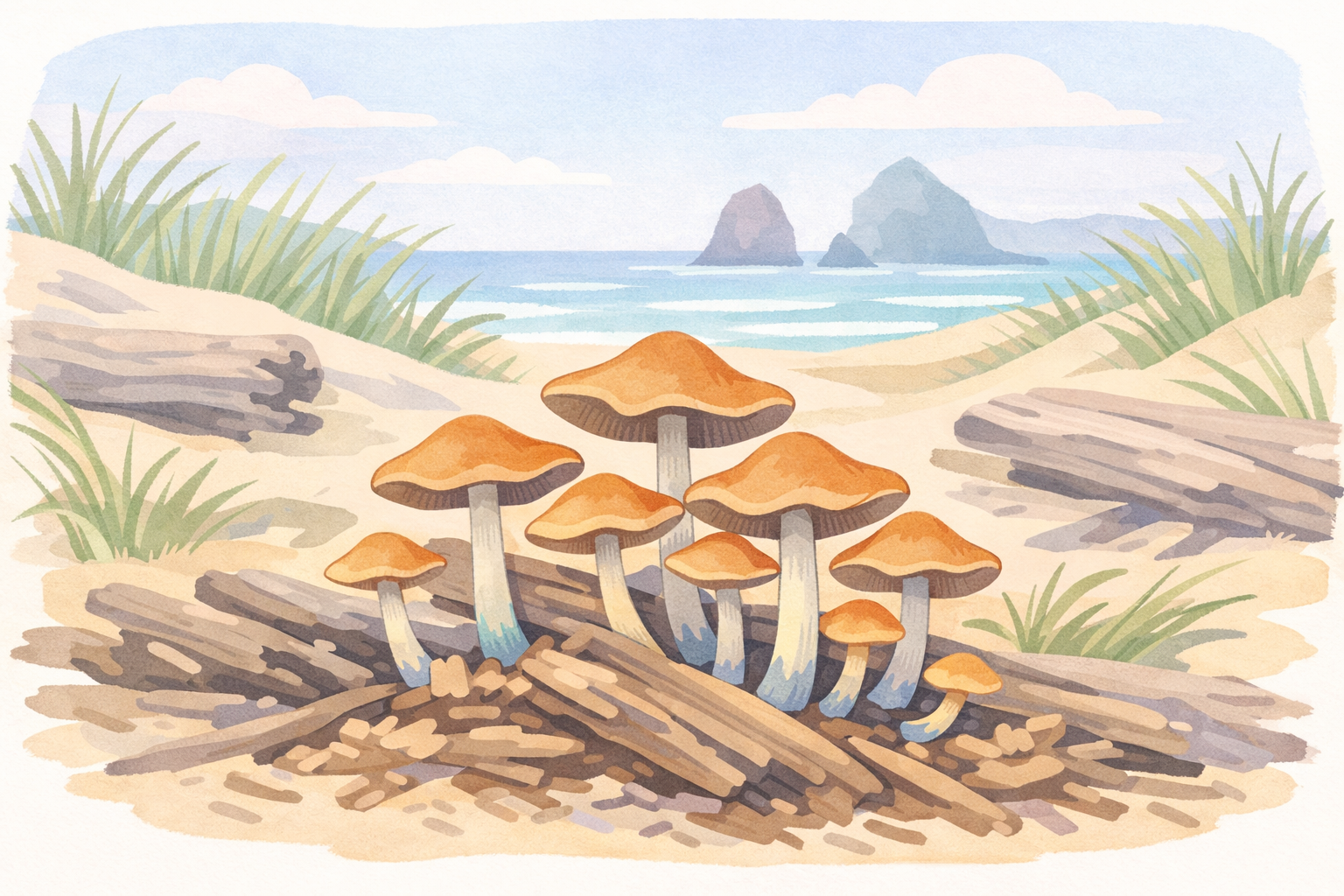
The habitat is characterized by sandy soils enriched with deciduous wood debris within dune grass communities, perfect conditions for P. azurescens to fruit. One of those dune grasses is ammophila maritima, which p. Azurescens seems to like. The mushroom grows as a saprotroph (feeding on decaying, organic matter), woody debris such as decomposing fallen branches and twigs, buried wood chips, amongst and under plants, and coastal flotsam and jetsam such as driftwood. This species seems to thrive at the edge of where different habitats meet and merge, such as where pinewoods meet coastal sand dunes.
Fruiting occurs in late September through December (sometimes into January). The species tolerates cold better than most Psilocybe mushrooms and has been known to tolerate temperatures between -4 and 20°C (25 to 68℉). Mushrooms appear in tight clusters and also fruit individually, adjacent to beach grasses. They tend to fruit in sandy, grassy soils that harbor woody debris that are shaded by pines. It is notoriously hard to grow these mushrooms indoors, and studies have shown that indoor cultivation may yield different results from naturally grown outdoor species.
Several toxic species can be mistaken for P. azurescens, particularly within the genera Galerina, Inocybe, and Stropharia, some of which are potentially deadly. This makes accurate identification essential when foraging in the wild. Key distinguishing features of P. azurescens include its pronounced bluing reaction, blackish-brown to purple spore print, and its characteristic cap shape and gill structure.
Safety, Legal Status & Harm Reduction
Psychological risks: Similar to other types of psychedelics. There is potential to face challenging experiences, anxiety, and the risk of triggering psychiatric conditions in vulnerable individuals. Higher potency means smaller dosing errors carry bigger consequences.
Wood lover's paralysis is rare, but it is a concern when considering this species and other species of wood-loving Psilocybes. A 2025 survey of 392 individuals found 42.1 percent reported WLP, with mobility impairment (80.4 percent), difficulty swallowing (26.7 percent), and breathing difficulty (16.6 percent). Nearly half experienced symptoms into the next day; 21.5 percent reported falls or accidents. Cognitive function remains, meaning you're aware but unable to move normally. The mechanism is unknown, and paralysis resolves without medical intervention in documented cases, usually within 24 hours. Although uncomfortable, WLP isn’t inherently dangerous. The real risk associated with WLP is contextual; for example, if it strikes when you are outdoors and you’re paralyzed in the elements and face conditions such as hypothermia, sun poisoning, or other natural phenomena.
Medication interactions: SSRIs may diminish effects or contribute to serotonin syndrome. MAOIs can unpredictably potentiate effects, and it’s best to avoid them entirely. Lithium combined with psilocybin has also been associated with seizures. Consult a physician and utilize a practitioner or retreat to safely consume any psychedelic mushrooms.
Set and setting: Basics apply with an extra dose of caution, given their potency. Controlled environments, trusted company, a clear intention, and a good guide can help mitigate any unwanted situations. The potential of paralysis makes these outcomes even more critical.
Legal status: Under U.S. federal law, psilocybin is Schedule I, meaning it is illegal. Several cities have decriminalized (Oakland, Santa Cruz, Seattle, Ann Arbor, D.C.) the use of psilocybin or allow for medical use in an approved setting. Internationally, psilocybin is controlled under the UN Convention on Psychotropic Substances.
Frequently Asked Questions
Sources
-
Barlow, C. (2024, July 18). An introduction to wood-lover's paralysis. DoubleBlind. https://doubleblindmag.com/wood-lovers-paralysis/
-
Beck, S. A., Barlow, C., Engel, L., & Barratt, M. J. (2025). "Wood-lover paralysis": Describing a toxidrome with symptoms of weakness caused by some lignicolous "wood-loving" Psilocybe mushrooms. Toxicon, 264, Article 108450. https://doi.org/10.1016/j.toxicon.2025.108450
-
Beckley Retreats. (2024, March 12). The evolution and history of psilocybin mushrooms. https://www.beckleyretreats.com/the-history-of-psilocybin-usage/
-
Beckley Retreats. (2025, October 23). Types of psychedelic mushrooms: A complete guide to psilocybin species around the world. https://www.beckleyretreats.com/types-of-psychedelic-mushrooms/
-
Dörner, S., Rogge, K., Fricke, J., Schäfer, T., Wurlitzer, J. M., Gressler, M., Pham, D. N. K., Manke, D. R., Chadeayne, A. R., & Hoffmeister, D. (2022). Genetic survey of Psilocybe natural products. ChemBioChem, 23(14), Article e202200249. https://doi.org/10.1002/cbic.202200249
-
Kurzbaum, E., Páleníček, T., Shrchaton, A., Azerrad, S., & Dekel, Y. (2025). Exploring Psilocybe cubensis strains: Cultivation techniques, psychoactive compounds, genetics and research gaps. Journal of Fungi, 11(2), Article 99. https://doi.org/10.3390/jof11020099
-
McTaggart AR, Scarlett K, Slot JC, Barlow C, Appleyard C, Gardiner DM, Fechner N, Tilden J, Hass D, Voogelbreinder S, Lording WJ, Lloyd RA, Shuey LS, Drenth A, James TY. (2024) Wood-loving magic mushrooms from Australia are saprotrophic invaders in the Northern Hemisphere. Fungal Systematics and Evolution – FUSE Journal 14:209-217.
-
Stamets P. & Gartz J (1995) Psilocybe azurescens. Integration: Journal for Mind Moving Plants and Culture 6: 21 (1995) [MB#446057]