-2-1.png)

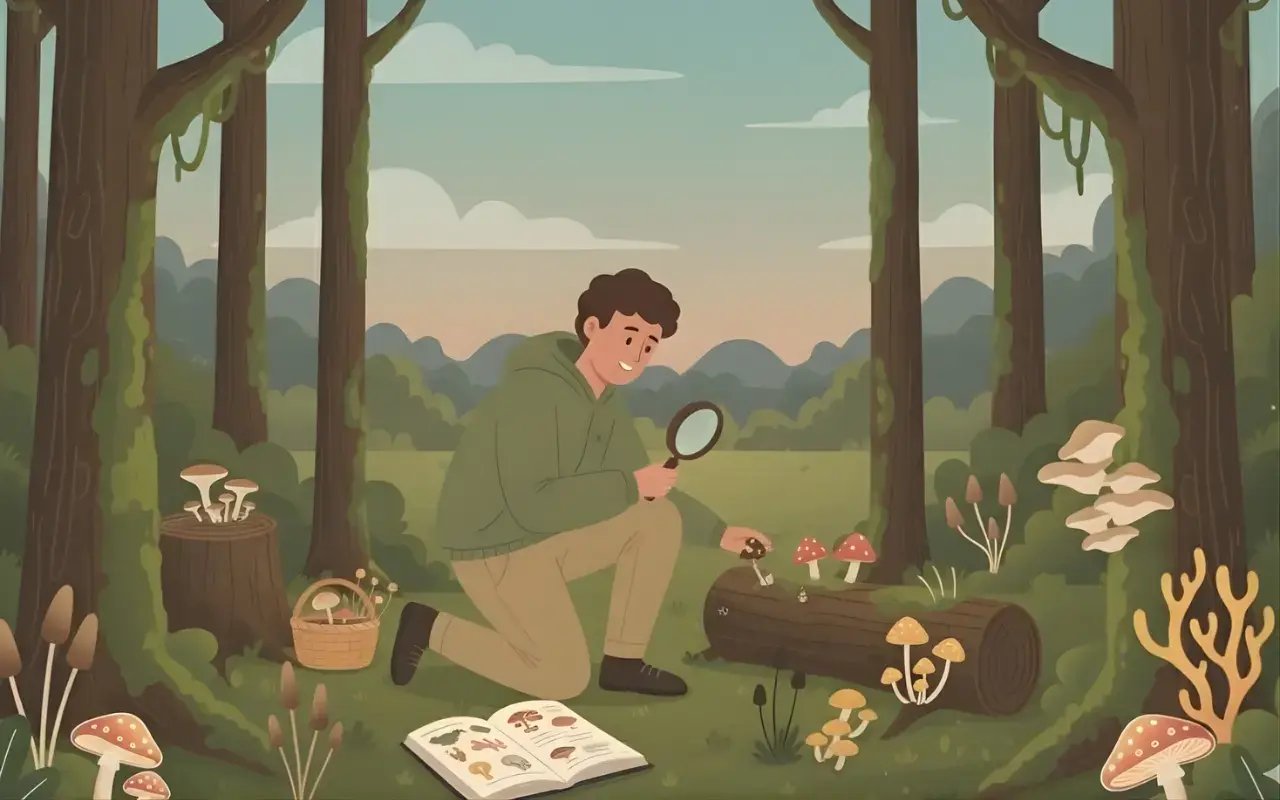
There isn’t one type of psychedelic mushroom, even though pop culture lumps them into the singular category of “magic mushrooms." There are, in fact, more than 200 species, all of which differ in their potency and appearance.
Understanding this diversity matters. Different species can vary several-fold in strength; some have deep Indigenous roots, some are simple to cultivate indoors or outdoors, and a few are now at the center of cutting-edge medical research (though synthetic lab-made psilocybin is more prominent in this arena). This guide explores the major types of psychedelic mushrooms, how they work, which species are most well-known, and how factors like potency, legality, safety, and culture shape their use in the modern world.
What Are Psychedelic Mushrooms?
Psychedelic mushrooms are fungi that produce the psychoactive compound psilocybin. When you ingest it, the psilocybin converts to psilocin, which binds to serotonin 5-HT2A receptors in the brain. This changes how different brain regions communicate, often increasing connectivity between areas that don’t typically interact. There is a particularly high density of these receptors in the neocortex of the brain, the newest, largest, and most complex part of the brain’s cerebral cortex, which governs higher functions like language, sensory perception, conscious thought, reasoning, and planning. The result is what you think of as a classic psychedelic experience: shifts in mood and perception, visual or sensory changes, an altered sense of time, and deep introspection.
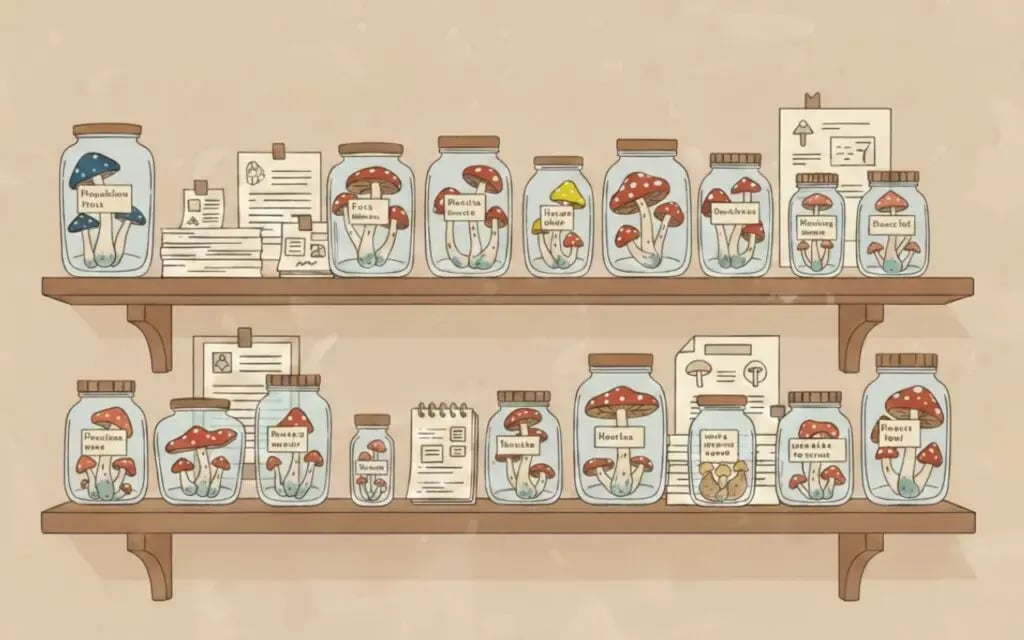
There’s evidence that psychedelic mushrooms have been used ceremonially for thousands of years. Indigenous groups in Mexico and Central America treated these mushrooms as sacred tools for healing and divination. In the 1950s, Mazatec healer María Sabina introduced these traditions to the West, gifting some to R. Gordon Wasson and his wife Valentina Wasson. A huge surge in interest in the mushrooms resulted, in part due to an article written by R. Gordon Wasson for Life magazine—sparking global interest but also leading to exploitation and disruption of her local community. Some Indigenous communities continue to protect these traditions, while Western science has re-embraced psilocybin in clinical research and therapy.
Major Psilocybin Mushroom Species
While more than 200 mushroom species contain psilocybin, a handful of them are commonly used for research and recreational use. These species vary in potency, habitat, appearance, and cultural significance. Below are the most well-known.
Psilocybe cubensis (“Gold Caps”)
Potency: Moderate (0.5-1% psilocybin)
Habitat: Subtropical/tropical regions, grows on herbivore dung
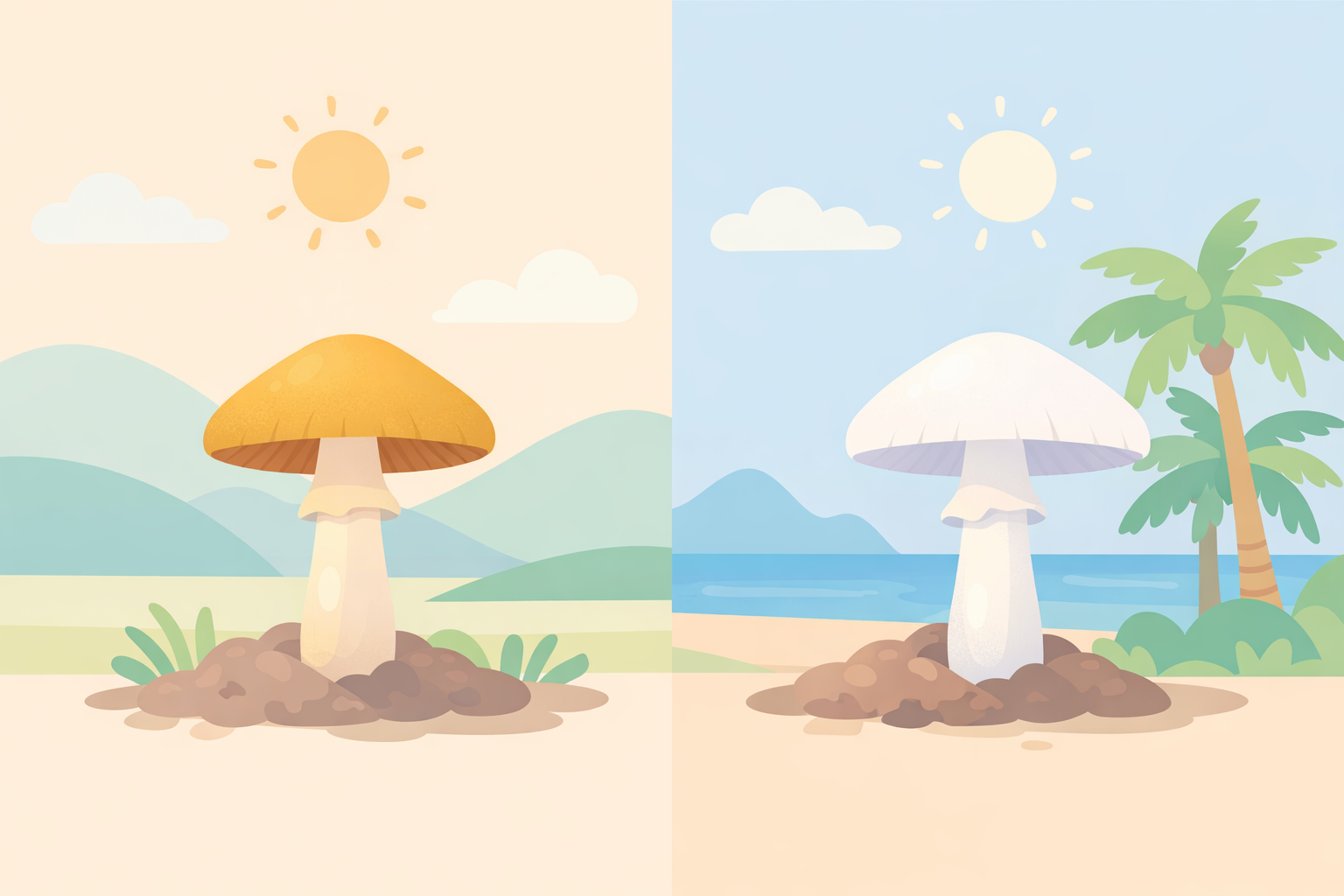
P. cubensis is the best-known psychedelic mushroom in the world because it’s relatively easy to cultivate indoors. It has a golden-brown cap, a thick stem, and bruises blue when handled. Dozens of cultivated strains exist, but these are all genetic variants of the same species. Some strains, like Penis Envy and Enigma, have been selectively bred for higher potency. Because it’s consistent and accessible, P. cubensis is the species most often used in research, therapeutic, and recreational / naturalistic contexts.
Psilocybe semilanceata (“Liberty Cap”)
Potency: High (1-2% psilocybin)
Habitat: Acidic grasslands, especially where sheep or cattle graze
This small mushroom is native to temperate regions across Europe and North America. It has a distinctive conical shape with a pointed tip. Despite its size, it is among the more naturally potent species. Liberty caps have been used recreationally in Europe for decades and remain one of the most commonly foraged psychedelic mushrooms in the world.
Psilocybe azurescens (“Flying Saucer”)
Potency: Very high (up to 2% psilocybin + psilocin)
Habitat: Coastal wood debris in the Pacific Northwest
Known as the “flying saucer mushroom,” P. azurescens produces large caramel-colored caps with wavy edges. First formally described in the 1990s, it naturally occurs in only a few coastal areas but is famous for its intense effects. Its combination of high psilocybin and psilocin content makes it one of the most potent species known.
Psilocybe cyanescens (“Wavy Cap”)
Potency: High (0.8-1.8% psilocybin)
Habitat: Wood chips, mulched garden beds, landscaping
P. cyanescens, or “wavy caps,” thrive in urban and suburban environments where wood mulch is used. They are commonly found in the Pacific Northwest, parts of Europe, and even city parks.
Psilocybe niveotropicalis
Potency: High (1.4-2.0% alkaloids)
Habitat: Wood mulch beds in Florida. This species appears to have a preference for human-engineered landscapes rather than wilder habitats. P. niveotropicalis is a species of warm weather wood-loving Psilocybe discovered in 2019 in southern Florida, known for its resilience, potency, large fruit bodies, and bountiful flushes. A promising species for outdoor cultivation in warmer regions.
Psilocybe ochraceocentrata
Potency: Medium-High (0.6 to 1.81% total alkaloids)
Habitat: A dung-loving species like P. cubensis, associated with Miombo woodland and mixed deciduous woodland, on granitic sand; recorded from Zimbabwe and South Africa. P. ochraceocentrata was previously, mistakenly referred to as P. natalensis (which remains its own separate species) before being distinguished and applied its current provisional species name. It is the closest living relative of the commonly cultivated P. cubensis, and considered around as easy to grow (although it may appreciate a little more fresh air exchange during fruiting). This mushroom has been making waves among the cultivator community as many prefer the experience it provides over that of P. cubensis, reporting less body load issues on ingesting it.
Psilocybe ingeli
Potency: Very High (2.3-4.2% total alkaloids).
Habitat: Manure enriched grassland pasture in South Africa.
Only scientifically described in 2023, this South African native is among the most potent Psilocybe mushrooms known. It is a member of Section Zapotecorum that requires high levels of humidity and fresh air during fruiting.
Psilocybe zapotecorum
Potency: Very High (2.25-4.17% PCBE / psilocybin equivalency)
Habitat: P. zapotecorum is widely distributed in the Neotropics, having been found in Guatemala, El Salvador, Nicaragua, Colombia, Chile, Brazil, Ecuador, Argentina, Venezuela, and Peru, in addition to Mexico. The mushrooms prefer moist habitats, having been found in ravines and near streams, rivers and waterfalls in mesophytic forests, oak-and-pine forests, or cloud forests between 900 and 3,200 m elevation, as well as in subtropical forests closer to sea level. P. zapotecorum, referred to as a “derrumbe” or landslide mushroom by the Mazatec, and badao zoo (“drunken mushroom”) by the Zapotec Indians. One of the most shamanically revered species used by Indigenous groups in Mexico such as the Mazatec, Zapotec and Mixtec, and held in very high regard by Western psilonauts. A slow fruiting species, which requires stable fruiting conditions with high humidity and fresh air levels, although cultivators consider it worth the wait.
Psilocybe subtropicalis
Potency: High-Very High (0.85- 4.85% PCBE / psilocybin equivalency).
Habitat: Coffee plantations, associated with clay soils, and also observed growing in open places of subtropical forests. Reported from Central and South America, including Mexico, Guatemala, Costa Rica, and Argentina, where it is reported growing at 1,000-1,800 meters in altitude. P. subtropicalis was previously referred to as P. semperviva, with this translating to “ever-living” in reference to its tenacious and long-lived nature. A slow fruiter, it can nonetheless potentially yield many flushes of potent mushrooms over an extended timeframe. A species held in high shamanic regard by the Mixetec and Zapotec Indigenous groups in Mexico. One standout feature of P. subtropicalis is that it produces highly potent mycelium.
Psilocybe Mexicana & Psilocybe Tampanensis (“Little Birds” & “Philosopher’s Stone)
Potency: Moderate (0.3-0.7% psilocybin)
Habitat: Mexico, Central America, and the southeastern U.S.
These species are notable for producing sclerotia, the underground nutrient storage units, also called “truffles”, which house the same psilocybin as is found in the mushrooms. Truffles are legal in certain countries (like the Netherlands) even when mushroom fruiting bodies are not, making them more accessible in some settings.
Panaeolus cyanescens (“Blue Meanies”)
Potency: High-Very High (2.5-4.05% psilocybin).
Habitat: A dung-loving species found across subtropical and tropical zones of the planet. It is notable for the speed of its growth (requiring high humidity and fresh air exchange during fruiting), and it is favoured by some psilonauts for the experience it provides. One strain of this species ‘TTBVI’ (Tamarind Tree British Virgin Islands) holds the current record for most potent magic mushroom in the world, having won several consecutive cultivar cups.
Psilocybe caerulescens
Potency: Medium-High (0.8-2.46% PCBE / psilocybin equivalency).
Habitat: Often fruits in disturbed clay-rich soils with woody debris often devoid of herbaceous plants (often found near rivers, streams, and ravines), with a tendency to fruit in large groups. A species held in high regard by numerous Mexican Indigenous groups and Western psilonauts alike. It is the species through which Timothy Leary and R. Gordon Wasson were both introduced to psilocybin.
Other Factors to Consider When Taking Mushrooms
It’s essential to understand how other factors, aside from the type of mushrooms, can impact the safety and quality of a trip. Potency (the percentage of psilocybin in the mushroom relative to its weight), the growing conditions, set, setting, and the legality.
At a Glance: Potency Hierarchy
You’ve got to know—or, at least, take mushrooms with someone who knows—how much psilocybin different species contain. For example, P. azurescens can contain nearly four times more psilocybin than P. cubensis, which means if you take the same dose of those two different species, you’re looking at two very different feeling trips.
- Very High: Psilocybe azurescens, Panaeolus cyanescens, P. ingeli, P. zapotecorum
- High: Psilocybe semilanceata (liberty caps), Psilocybe cyanescens
- Moderate: Psilocybe cubensis, Psilocybe mexicana, Psilocybe tampanensis (truffles)
Note that potency can vary within species as well.
What Influences Potency Beyond Species?
Even within the same species, strength can vary significantly due to:
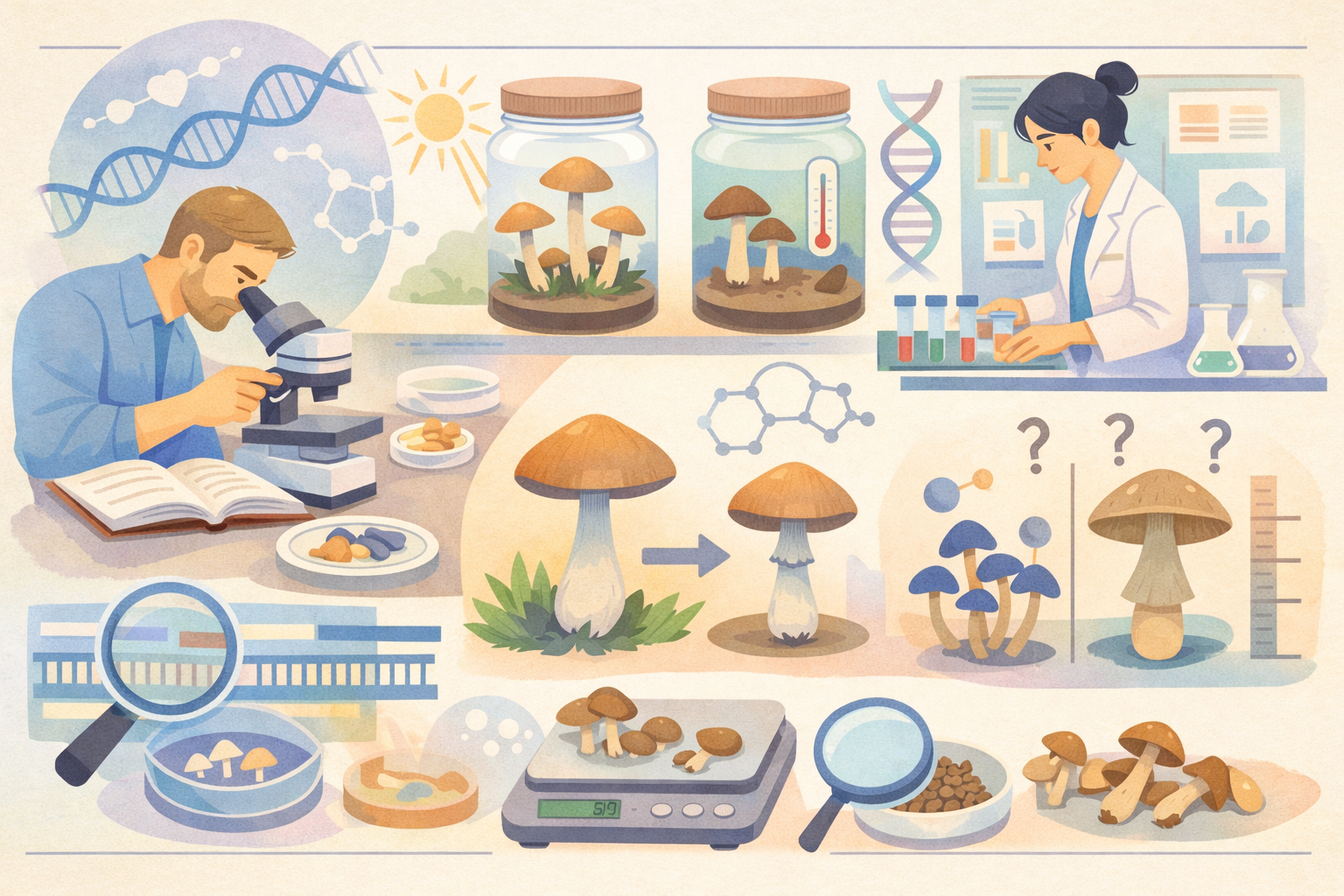
- Growing conditions: Temperature, humidity, and substrate can influence the production of alkaloids.
- Maturity at harvest: Younger mushrooms may have a higher concentration by weight, but larger mushrooms contain more total psilocybin.
- Genetics: Different strains or isolated cultures within a species can vary.
- Storage and preparation: Heat, light, moisture, and oxygen degrade psilocybin over time. Well-dried and properly stored mushrooms are more potent.
The species of a mushroom is a strong indicator of potency, but it’s not the only factor. Identifying the mushroom and understanding where it came from is critical for safe and accurate dosing.
Do Different Species Feel Different?
Not really. All psilocybin mushrooms elicit the same core effects: Altered perception and visuals, emotional shifts, an altered sense of time, and the ability to look inward. Some people say specific species can feel more “visual” or “body heavy”—anecdotal claims that are hard to verify scientifically.
In addition to psilocybin/psilocybin, there are a range of other compounds found in these fungi. These include tryptamines such as baeocystin, norbaeocystin, norpsilocin and aeruginascin, a number of beta-carbolines (in trace amounts) and a range of terpenes. While the jury is still out on the possible modulating influence of these other secondary compounds in these fungi, our understanding of the pharmacology of these compounds is limited.
If a specific species feels different to you over another, it’s probably due to the dosage, any additional compounds, and your set and setting, which is clinical speak for your mental state and physical setting going into the experience. Your set and setting play a significant role in the overall experience you have.
This being said, it is worth noting that experienced psilonauts and cultivators who have sampled a range of different mushroom species very often tend to hold certain species in higher esteem than the more commonly cultivated and consumed P. cubensis. While many have the view that “a cube is a cube”, when applied to the purported and possibly overhyped differences in effect attributed to the many different strains of P. cubensis, some feel things become more interesting when considering differences between distinct species of mushroom. Some will feel strongly enough about their preference for other species that they will forego ever growing and consuming P. cubensis mushrooms again having sampled what they perceive as superior species, considering them as “cube killers”.
For example, Richard Gutierrez, who played a key role in developing the popular “Penis Envy” strain of P. cubensis, notably does not like to partake of this mushroom himself, not having done so since the 1970s. In an interview with Hamilton Morris, he said that “it’s never been my mushroom of choice; I’ve always eaten [Psilocybe] cyanescens.”
Intriguingly, the Mazatec and other Indigenous groups who have long used these mushrooms in their rituals tend to take the view that different species have distinct qualities or their own ‘signature’, with certain species revered over others or considered preferable for specific purposes. P. cubensis does not tend to be held in the highest regard in comparison to other species by the Mazatec. This view is shared by ethnobotanist Kathleen Harrison, who has worked extensively with the Mazatec and various Psilocybe species. The Mazatec are considered to posses the greatest knowledge of Psilocybe mushrooms among the various Indigenous Mexican groups that use these fungi, and having used them for centuries, they may know a thing or two we don’t.
Duration
Most psilocybin mushroom experiences last 4 to 6 hours, with the trip peaking at the one-and-a-half to two-hour mark. After effects may linger for several hours. Duration is generally similar across species, though high-potency species may feel more intense, and may extend the duration.
Legal and Ethical Considerations
Psilocybin remains a Schedule I controlled substance in the United States and is similarly restricted in most countries, making it illegal to possess and sell. However, the legal landscape is evolving:
- Several U.S. cities and states have decriminalized psilocybin possession or use. Though decriminalization typically means reduced penalties, not legality.
- Oregon and Colorado have created legal frameworks for supervised psilocybin services.
- Research exemptions allow scientific studies at major universities.
- Some countries like Jamaica, the Netherlands (for truffles), and Brazil have more permissive legal environments.
Ethically, harvesting mushrooms raises some conservation concerns. Over-collection can damage ecosystems and deplete local populations. Many mycologists (people who study fungi) and environmentalists advocate for cultivation rather than wild foraging to reduce pressure on natural populations.
Also, it’s respectful to acknowledge the indigenous traditions around mushrooms. The commercialization and appropriation of sacred practices without acknowledgment or benefit to source communities represents an ongoing ethical concern.
How to Use Mushrooms Responsibly
Set and Setting
As mentioned above, there are other factors aside from the species that significantly impact your trip experience. Set refers to your mindset, expectations, personality structure, mood and emotional state, mental and physical health, past experiences, and intent for the session. Setting is the physical, social and cultural environment.
Research consistently shows that set and setting are crucial to having a positive experience, implying that adverse outcomes correlate more strongly with poor set and setting than with dose or species. A moderate dose in a comfortable, supported environment produces vastly different outcomes than the same dose in a chaotic setting.

Also, it’s crucial to undergo medical screening before taking psilocybin, as it can be contraindicated for people with certain cardiovascular conditions, those taking specific medications, or individuals with personal or family histories of psychotic disorders. Any legitimate retreat, like Beckley Retreats, will bake this into its onboarding process, before allowing you to embark on a ceremony.
Integration and Post-Experience Care
The experience itself is only part of the picture. Integration is the process of making sense of insights and incorporating them into daily life, which often determines long-term benefits. This might involve journaling, therapy, discussion with trusted friends, or participation in integration circles.
Modern therapeutic approaches combine psilocybin sessions with extensive preparation and integration support, recognizing that the medicine catalyzes change but doesn’t create lasting transformation alone.
First described from Cuba in 1906 as Stropharia cubensis and moved into Psilocybe by Rolf Singer in 1949, P. cubensis became the most cultivated species after the McKenna brothers published their grower's guide in the 1970s. Golden Teacher is its best-known cultivar. It grows on dung in tropical and subtropical pasture, leaves a purple-brown spore print, and typically runs 0.5 to 1 percent alkaloids by dry weight, which is why it is the reference point most other species are compared with.
A small conical grassland species, the liberty cap has been recorded in more than 35 countries and gave the first documented psychoactive report, in London in 1799. Psilocybin averages around 1 percent by dry weight, among the more potent wild species. It is one of many small brown mushrooms that look alike, so misidentification in the field is a real risk.
A wood-loving species of the Pacific Northwest coastal dunes. Analyses by Stamets and Gartz found psilocybin concentrations roughly three times those of Golden Teacher, the highest among naturally occurring Psilocybe, along with elevated baeocystin, a related compound whose contribution to the experience is poorly understood. It has been cultivated outdoors in cool climates from Oregon to the Netherlands and New Zealand.
The wavy cap grows on wood chips and woody debris in the Pacific Northwest, British Columbia, western and central Europe and, more recently, New Zealand. Potency is variable, with analyses reporting up to about 1.7 percent psilocybin. The deadly Galerina marginata can grow in the same beds and looks similar; the dark purple-brown spore print of Psilocybe, against the rusty brown of Galerina, is the reliable way to tell them apart.
Found in 2019 by hobbyist mycologist Scott Ostuni in an irrigated mulch bed in Jupiter, Florida, and so far recorded only in Palm Beach County, always in landscaped ground. It fruits from January to mid-September outside the summer months, has a notched, heart-shaped cap, bruises blue, and is thought to be somewhat more potent than P. cubensis, though data is thin.
Described from Africa by Bradshaw and colleagues in Proceedings of the Royal Society B in 2026, it appears to be the closest known relative of P. cubensis, sharing a common ancestor more than 1.5 million years ago. It has a yellow-brown cap with a distinct central spot and had already circulated among growers mislabelled as a P. natalensis strain called Natal Super Strength. Reported effects are similar to cubensis, with some people describing a smoother onset.
Described in 2024 by van der Merwe and colleagues in Mycologia from South Africa. It grows in clusters with a caramel-coloured cap, a lighter rim and a strong indigo bruising reaction. Early analyses put total alkaloids at 2.3 to 4.2 percent by dry weight, among the most potent known, so a single gram of dried material can exceed the 25 milligram dose used in most clinical studies.
Native to the highlands of Oaxaca and documented in Zapotec use, it was studied in the mid-twentieth century by R. Gordon Wasson and mycologist Gaston Guzman. One of the larger species in the genus, with caps that can exceed 12 centimetres and thick, hollow, twisted stems, it fruits from disturbed, mineral-rich soil in humid ravines and cloud forest. Analyses find some of the highest combined psilocybin and psilocin levels recorded.
Native to the humid subtropical and montane forests of southern Mexico and parts of Central America, and formerly classified as P. hoogshagenii var. convexa. Small, with a distinctly conical cap and deep blue bruising, it grows from soil and forest litter, including shaded coffee plantations, and is regarded as high to very high in potency.
Both species form sclerotia, the dense underground masses sold as truffles, which is the form that is legal in the Netherlands and the one Beckley uses there. Samples of P. mexicana analysed by Albert Hofmann in 1958 led to the first isolation of psilocybin and psilocin. P. tampanensis was found near Tampa, Florida in the 1970s by Steven Pollock, and most cultures in circulation trace back to that single collection.
Called derrumbe, the landslide mushroom, because it fruits after heavy rain on steep, freshly shifted soil in Oaxaca rather than in pasture or on wood. Long used by Mazatec healers including Maria Sabina, it is the species R. Gordon Wasson described in his 1957 Life magazine article. Potency is moderate to high.
Frequently Asked Questions
Before you apply
Beckley runs legal, guided psilocybin retreats in Jamaica and the Netherlands: four weeks of preparation, two guided sessions on retreat, six weeks of integration, online and at your own pace, one to two hours a week. Plain answers to the questions people ask first:
What a psilocybin retreat costs · What happens, day by day · Jamaica or the Netherlands · Who should not attend · Apply
Sources
- Ullrey, A. M. (Ed.). (2024, October). Ritual and religious uses of Psilocybe mushrooms in Mesoamerica. Center for the Study of World Religions, Harvard Divinity School. https://cswr.hds.harvard.edu/news/2024/10/ritual-and-religious-uses-psilocybe-mushrooms-mesoamerica
- Maria Sabina and a brief history of Magic Mushrooms. (2022, October). FungaOnline. https://fungaonline.com/instead-of-history-of-plant-medicines/
- Van Court, R. C., Wiseman, M. S., Meyer, K. W., Ballhorn, D. J., Amses, K. R., Slot, J. C., Dentinger, B. T. M., Garibay-Orijel, R., & Uehling, J. K. (2022). Diversity, biology, and history of psilocybin-containing fungi: Suggestions for research and technological development. Fungal Biology, 126(4), 308–319. https://doi.org/10.1016/j.funbio.2022.01.003
- Godfrey, K., Weiss, B., Zhang, X., Spriggs, M., Peill, J., Lyons, T., Carhart-Harris, R., & Erritzoe, D. (2025). An investigation of acute physiological and psychological moderators of psychedelic-induced personality change among healthy volunteers. Neuroscience Applied, 4, 104092. https://doi.org/10.1016/j.nsa.2024.104092