-2-1.png)


Part of the charm of folklore lies in its mystique; we’ve all heard tales of ancient religions and cultural practices lost to time that purport to connect people to something greater than what we can typically observe with our five physical senses.
Here’s the thing: Mystical isn’t synonymous with “made up.” For thousands of years, cultures all over the world have used shamanism and its practices to find solace, explore the human condition, seek healing, communicate with the more-than-human, and catalyze spiritual breakthroughs.
Today, shamanistic tenets have their fingerprints everywhere - in mental health, medicine, and, yes, psychedelics as well. We’re drawing a throughline from the origins of shamanism to the modern day.
What Is Shamanism?
Shamanism is one of the world’s oldest spiritual practices. The word shaman, from the Manchu-Tungus šaman (which means “one who sees in the dark”) is believed to be derived from East Asian tribes, though the exact origins are disputed by scholars. The first instance of shaman being used in English was around the year 1700, when German merchant Adam Brand recounted his experiences in China.

Shamanism is rooted in animism - an ancient, transcultural worldview shared by Indigenous cultures worldwide that views humans as part of an interconnected web of life that unites the visible material world and the invisible spirit world). The chief tenets of shamanism are the awareness that spirit permeates all creation, attunement to the spirit world, and the deep interconnectedness shared by all beings. Through ritual practices (and with the assistance of certain psychedelics), the shaman acts as a spiritual conduit to influence, inspire, and heal.
Historical Significance
Shamanism arose in ancient cultures and hunter-gatherer communities before being adopted by Western culture. According to anthropological research, shamanic leaders used their spiritual attunement, social leverage, and effective healing techniques to achieve cultural prominence, rather than martial strength.
However, shamanism as a cultural structure was not entirely peaceful or rosy. Scholars have described how ancient shamans “attained positions of influence through their charisma and knowledgeability, social unification, healing competence, and use of supernatural powers to cause harm.”

Shamanic rituals - think drumming, chanting, dancing, and other “synchronic activities” - were also commonly integrated into foraging cultures as a means of maintaining social cohesion during long stretches in the wilderness.
Crucially, shamanism as a practice is believed to have arisen as a “cultural adaptation of hunting and gathering societies to the biological potential for altered states of consciousness.” Ancient hunter-gatherers likely encountered and consumed natural psychoactives, like psilocybin-containing mushrooms. Shamanism became the framework through which ancient cultures interpreted the effects of and used psychedelics.
In the first known artistic depiction of a shamanic leader conducting a ritual, Dutch explorer Nicolaes Witsen described the shaman as a “priest of the Devil,” even going as far as to draw the shaman with clawed feet and other demonic features.
Modern Shamanism
Contemporary shamanism has, as with many cultural renaissances, forked into multiple separate ideologies - and there’s plenty of squabbling as to the legitimacy of each. According to writings from the Foundation for Shamanic Studies, modern shamanic practice falls into one of two main camps:
- Literal interpreters of ancient Shamanic practice, who attempt to follow its historical tenets to the letter
- “Core” or “Neo-shamanists,” who appropriate portions of traditional shamanism that align with modern cultural contexts, focusing on the synergy between the past and present
It is the latter that influences many psychedelic therapy practices today. Group-based activity, immersion in nature, consumption of psychoactive substances, and detachment of one’s consciousness from one's physical form all form part of shamanism.
Shamanism & Psychedelics: The Bridge
Psychedelics are a catalyst behind shamanism and spiritual illumination. While not strictly essential to all shamanic practices, psychedelics were and remain integral to the proliferation of shamanism in a small number of cultures globally.

Today, there’s a clear and clinically verified link between shamanism and psychedelic therapy - researchers have observed how shamans “manipulate the extrapharmacological effects” of psychedelics to access dormant regions of the brain.
How Psychedelic Therapies Use Shamanism for Deep Healing
Scientists and scholars have begun to recognize something obvious to the psychedelic and alternative medicine communities: “Psychedelic treatments can adopt the shamanic biogenetic paradigm” to optimize the therapeutic effect.
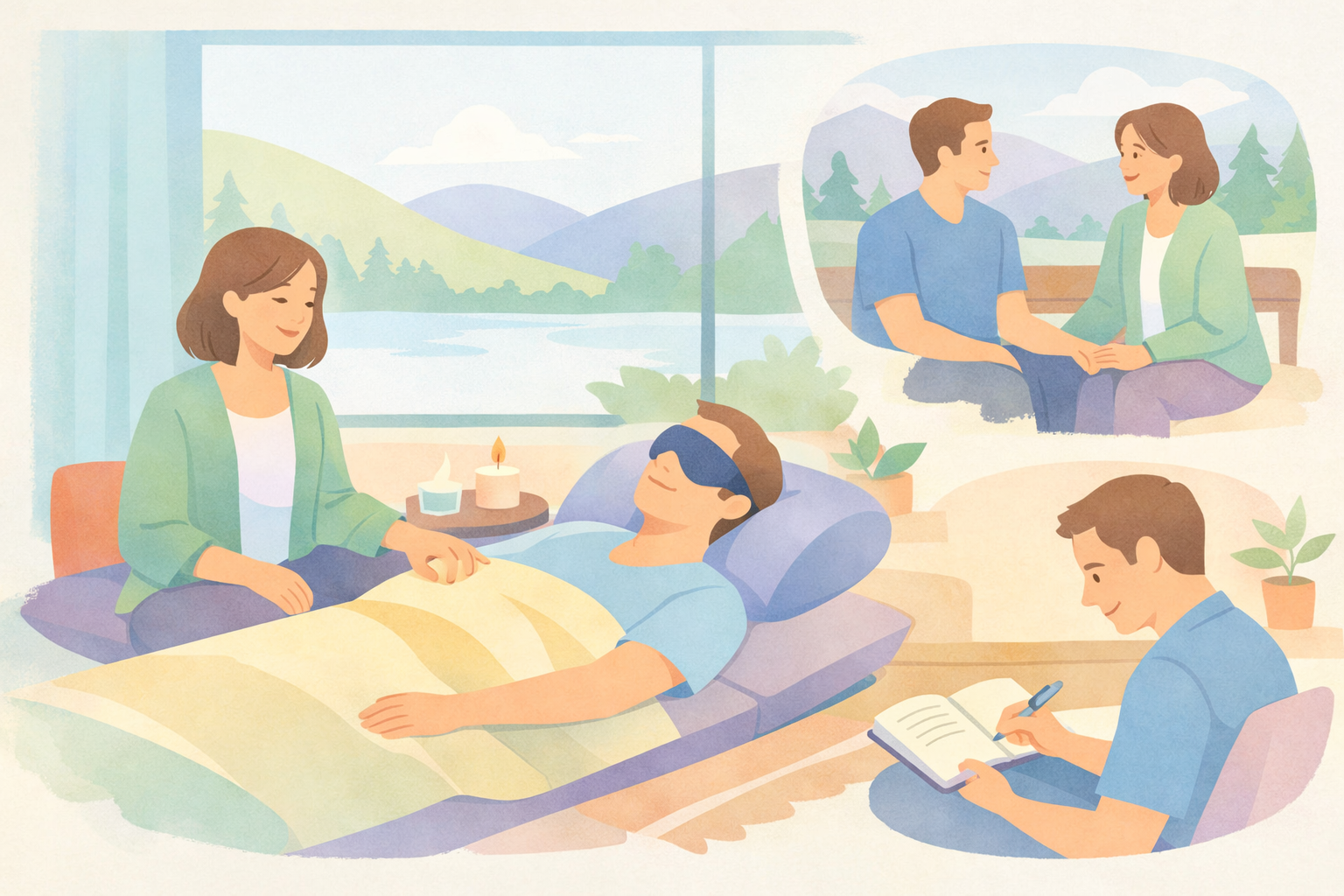
The three pillars of effective psychedelic therapy are
- Set: Your mindset and intention going into the therapy
- Setting: The physical and social environment you’re in
- Integration: Post-session processing and adoption of lessons from the experience
Here’s how each element of psychedelic therapy has ties to shamanism.
Set
Studies tell us that shamanistic rituals often utilized primitive “pre-screens” like sexual abstinence, fasting, or dream journaling to help participants mentally prepare before ingesting a psychoactive substance.
Modern psychedelic retreats employ similar screenings, but with more concern for and heed paid to medical history and informed consent. Prior to joining a psychedelic retreat or entering into clinical psychedelic-assisted therapy, you’ll complete rigorous medical background checks.
Pre-session questionnaires and interviews are common practice as well, to ensure you understand the journey you’re about to embark on, and to help the therapist or sitter understand your unique needs.
Setting
Ancient shamanistic rituals were carefully curated. Shamans used their environment to inform the spectacle - totems, effigies, natural ornaments, and sacred idols were all part of the show. Modern psychedelic retreats borrow these ideas, but with greater emphasis on safety and serenity. Contrary to some shamanistic rituals of old, psychedelic rituals are not meant to intimidate, frighten, or spark superstition.
Today, group retreats are held in secluded settings, steeped deep in nature, and under the supervision of qualified professionals who know how to physically steward participants as they wade through new states of consciousness.
Integration
Psychedelics were used in shamanism to provide spiritual enlightenment. While some may scoff at the concept if examined through a modern-day lens, the idea is backed by legitimate cognitive science. “Psychoactives … emphasize the connection with the divine,” some researchers have said. “This is the result of the substance’s potential to deconstruct the individual’s relational set, allowing for a loss of ego … and intense imaginative experiences.”
Put plainly, psychedelic experiences, whether in a clinic or around a campfire a thousand years ago, generate a tremendous amount of “raw material.” Shamans were the interpreters of these feelings in ancient times. Today, psychedelic integration techniques help modern users make sense of the ineffable.
Integration refers to everything that comes after a psychedelic experience. Instead of gleaning wisdom from the shaman, users today use guided talk therapy, journaling, deep reflection, and other integration practices to convert their experiences into practical, tangible change. When followed, this “afterglow”, which can last several weeks, has been shown to create long-lasting changes in perspective and improve mental health as well.
Frequently Asked Questions
Sources
1. Britannica Editors. (2026, January 23). Shamanism. In Encyclopædia Britannica. Retrieved March 9, 2026
2. Zachary H. Garfield, Kristen L. Syme, Edward H. Hagen, Universal and variable leadership dimensions across human societies, Evolution and Human Behavior, Volume 41, Issue 5, 2020, Pages 397-414, ISSN 1090-5138
3. WinkelmanM. J. (2010). Shamanism: A Biopsychosocial Paradigm of Consciousness and Healing.Santa Barbara, CA: ABC-CLIO.
4. Rodríguez Arce JM and Winkelman MJ (2021) Psychedelics, Sociality, and Human Evolution. Front. Psychol. 12:729425. doi: 10.3389/fpsyg.2021.729425
5. Dobkin de Rios M, Winkelman M. Shamanism and altered states of consciousness: an introduction. J Psychoactive Drugs. 1989 Jan-Mar;21(1):1-7. doi: 10.1080/02791072.1989.10472137. PMID: 2656946.
6. Fang XY, Fei PF, Zhu JP, Yuan B. [Research on hallucinogenic drugs used in Shaman religious activities]. Zhonghua Yi Shi Za Zhi. 2017 Jul 28;47(4):230-236. Chinese. doi: 10.3760/cma.j.issn.0255-7053.2017.04.008. PMID: 28954366.
7. Hutton, Ronald (2001). Shamans: Siberian Spirituality and the Western Imagination.
8. Winkelman MJ. The Evolved Psychology of Psychedelic Set and Setting: Inferences Regarding the Roles of Shamanism and Entheogenic Ecopsychology. Front Pharmacol. 2021 Feb 23;12:619890. doi: 10.3389/fphar.2021.619890. PMID: 33732156; PMCID: PMC7959790.
9. Beggiora, S. (2025). Shamanism and Psychoactives: Theory, Practice and Paradoxes of a Field Study in India. Psychoactives, 4(2), 8.
10. Evens R, Schmidt ME, Majić T, Schmidt TT. The psychedelic afterglow phenomenon: a systematic review of subacute effects of classic serotonergic psychedelics. Ther Adv Psychopharmacol. 2023 May 29;13:20451253231172254. doi: 10.1177/20451253231172254. PMID: 37284524; PMCID: PMC10240558.
Before you apply
Beckley runs legal, guided psilocybin retreats in Jamaica and psilocybin retreats in the Netherlands: four weeks of preparation, two guided sessions on retreat, six weeks of integration, online and at your own pace, one to two hours a week. Plain answers to the questions people ask first:
What a psilocybin retreat costs · What happens, day by day · Jamaica or the Netherlands · Who should not attend · Apply