
-2-1.png)


You’ve put in the months or years of work in therapy, and now you’re starting to feel that you’re stuck. Maybe you’re considering finding a new therapist or quitting therapy altogether. Many people find this frustrating, but it may not be that the therapy (or you) is failing. This may simply be a therapy plateau, which can be a normal part of long-term mental health work.
Much like any other type of growth, healing isn’t always a linear path. While you may have made great strides in the beginning of your sessions, it doesn’t mean you’ll always have the same growth rate throughout the entire lifespan of your therapy sessions. Plateaus can signal that something in your treatment plan needs a second look, such as your goals, approach, therapist, diagnosis, or the level of care you’re receiving.
Why Therapy Can Stop Feeling Helpful
- Your goals have shifted or become unclear: What may have felt urgent when you started therapy may no longer feel as intense, and other thoughts and realizations may be surfacing. So your sessions may start to feel redundant if you and your therapist are still working from the original plan or touching on things that no longer feel relevant.
- The same patterns keep resurfacing: Returning to the same material without new insight or forward movement is a sign of stagnation.
- The modality no longer fits: Cognitive Behavioral Therapy (CBT), for example, is designed as a short-term, structured approach that typically runs for about 5 to 20 sessions. CBT may have made sense for the initial need, but as you heal, you may find you need a different method.
- The therapeutic relationship may need a reset: The Mayo Clinic notes that having a good relationship with your therapist is critical for effective treatment. A mismatch can stall progress, make you feel unable to share openly and honestly, or push you to quit.
- Between-session work has dropped off: Homework, journaling, and skill practice between sessions reinforce what happens during the session. That between-session practice is an important factor in creating progress in CBT. When that work fades, progress in sessions often does, too.
How to Tell If You’ve Hit a Real Plateau
It’s important to distinguish between discomfort and plateauing. When you are processing difficult material during therapy, sometimes it can feel worse before it feels better. However, if you only ever feel worse with no sense of positive movement, that may be a sign of a poor therapeutic fit rather than something being off with you.

That experience is not the same as a plateau, where each session starts to feel repetitive without new outcomes, or when your symptoms are unchanging or worsening despite working towards healing.
Another way therapy can plateau is if your therapist stops giving you skills and tools to use outside of the office. It may be that you show up frustrated, hurt, or angry, and therapy provides a safe space to vent, but you don't feel equipped to handle these challenges outside the session. Venting has its place, especially early on during a real crisis, but that relief is going to be short-lived if you’re only seeking validation from your sessions.
What to Discuss With Your Therapist
If you don't feel you are benefiting from therapy after several sessions, whether early in your journey or later, Mayo Clinic suggests raising it directly with your therapist, who may suggest adjustments or a different approach.
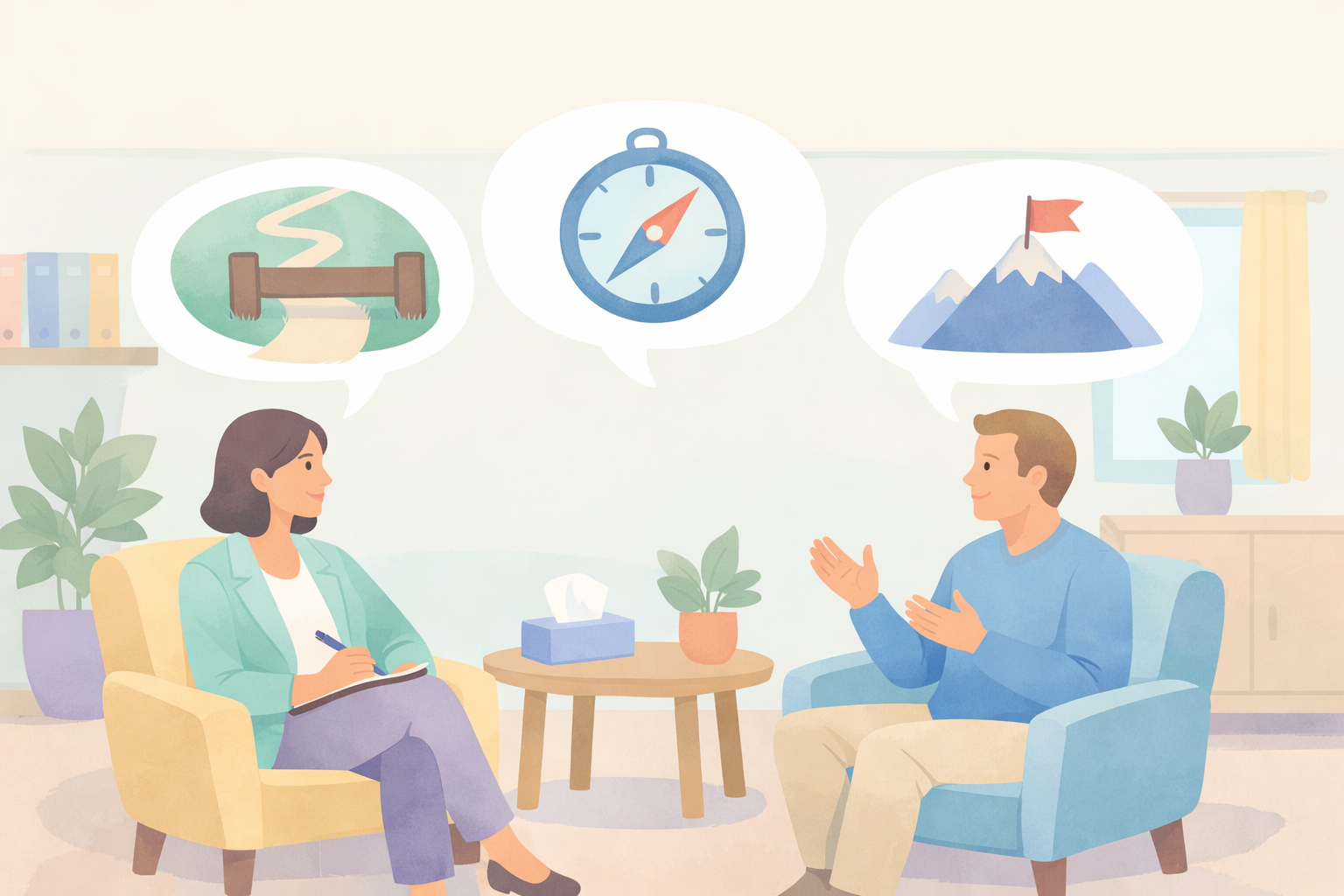
A few things that you can bring up:
- Revisiting your goals: Are you still working on the goals you established when you started therapy? Do you have new goals or feelings that have surfaced that you want to tackle?
- Try a new modality: Would a different approach fit better, given what you’re feeling now? Trying something like psychodynamic work, Internal Family Systems, or Dialectical Behavior Therapy may prompt new understanding and healing.
- Name what feels stuck and be specific about it. If you feel you’re not getting the skills, understanding, or growth you’re hoping for, tell your therapist. They will have ideas on how to navigate the obstacle.
When It May Be Time for a Different Approach
If therapy has hit a ceiling with your current setup, think about it as an obstacle in the road that you need to work around. Switching to a new therapist, or seeing someone with specialty training in modalities such as Eye Movement Desensitization and Reprocessing (EMDR) or Dialectical Behavior Therapy (DBT), or in areas like substance use, may offer what you need.

Some mental health conditions respond best to a combination of therapy and medication. It may be worth speaking with your primary healthcare provider or a psychiatrist about whether medication could support your treatment.
The APA’s clinical practice guideline for adult depression similarly emphasizes that treatment plans should be tailored to the individual, drawing from a range of psychological and pharmacological options based on the patient’s symptoms and results. Group therapy, intensive outpatient programs (IOPs), and partial hospitalization programs (PHPs) offer structured support that’s more intensive than a weekly session. Each person should be matched with what would benefit them most.
When Standard Therapy Isn’t Enough
For some people, therapy may not be enough, and that isn’t a human failure. The National Institute of Mental Health (NIMH) notes that ongoing research focuses on developing and testing therapies for people with treatment-resistant depression who do not improve after trying multiple options. The FDA has cleared electroconvulsive therapy (ECT) to treat severe depressive episodes in people 13 and older, including those suffering from treatment-resistant depression, and most patients responded within six to 12 treatments, though it is not effective for everyone.
Other options, such as repetitive transcranial magnetic stimulation (RTMS) and vagus nerve stimulation, have also received FDA clearance for certain conditions. Any conversations about these treatments should happen with your mental health care provider, who can evaluate if they are appropriate and safe for you.
Ketamine and esketamine have become popular options for treatment-resistant depression, and they work differently from traditional antidepressants. Esketamine is a nasal spray approved by the FDA in 2019 for adults with treatment-resistant depression, used alongside an oral antidepressant. Ketamine itself is not FDA-approved for depression, but is prescribed off-label, typically administered as an IV infusion in a clinical setting.

Research on real-world outcomes has shown that ketamine may meaningfully reduce symptoms for many people in this population, including those who haven't responded to multiple previous treatments. These options require medical supervision and aren't a fit for everyone.
Psilocybin, the psychoactive compound in certain mushrooms, is another option drawing attention for treatment-resistant depression, though it is still investigational and not FDA-approved. It received an FDA “breakthrough therapy” designation for TRD in 2018, and a 2024 systematic review and meta-analysis of randomized controlled trials evaluated psilocybin’s efficacy and acceptability for primary and secondary depression, finding evidence of antidepressant effects across the included trials. In the studies showing benefit, psilocybin is paired with structured psychological support from trained clinicians.
If symptoms are worsening, or if you’re having thoughts of harm to yourself or others, seek urgent support. You can reach out to your local provider, an emergency department, 911, or the 988 Suicide and Crisis Lifeline.
Frequently Asked Questions
Sources
- Alnefeesi, Yazen, et al. "Real-World Effectiveness of Ketamine in Treatment-Resistant Depression: A Systematic Review & Meta-Analysis." Journal of Psychiatric Research, vol. 151, July 2022, pp. 693–709.
- American Psychological Association. "Clinical Practice Guideline for the Treatment of Depression Across Three Age Cohorts." American Psychological Association, Feb. 2019.
- Mayo Clinic Staff. "Cognitive Behavioral Therapy." Mayo Clinic, 26 Feb. 2025.
- Mayo Clinic Staff. "Psychotherapy." Mayo Clinic, 11 Apr. 2023.
- National Institute of Mental Health. "Brain Stimulation Therapies." National Institute of Mental Health, Mar. 2024.
- National Institute of Mental Health. "Brain Stimulation Therapies." National Institute of Mental Health, Mar. 2024, www.nimh.nih.gov/health/topics/brain-stimulation-therapies/brain-stimulation-therapies.
- National Institute of Mental Health. "Depression." National Institute of Mental Health, Dec. 2024.
- Strunk, Daniel R., et al. "Patients' Competence in and Performance of Cognitive Therapy Skills: Relation to the Reduction of Relapse Risk Following Treatment for Depression." Journal of Consulting and Clinical Psychology, vol. 75, no. 4, 2007, pp. 523–530.
Before you apply
Beckley runs legal, guided psilocybin retreats in Jamaica and psilocybin retreats in the Netherlands: four weeks of preparation, two guided sessions on retreat, six weeks of integration, online and at your own pace, one to two hours a week. Plain answers to the questions people ask first:
What a psilocybin retreat costs · What happens, day by day · Jamaica or the Netherlands · Who should not attend · Apply