-2-1.png)


Consuming psychedelics can be transformative, illuminating experiences, but there are also a lot of unknowns and plenty of anxiety to go around if you’ve never taken part before. Feeling a bit intimidated or apprehensive is normal.
Psilocybin retreat programs take the guesswork out of the equation. Whether you’re investigating retreat options for personal growth, mental health support, or a deeper dive into the world of psychedelics, a curated environment and competent team can make all the difference.
Consider this guide your framework for evaluating psilocybin retreats. In this article, we’ll cover everything from staff qualifications to aftercare & integration, plus green and red flags to seek out and steer clear of.
What Is a Psilocybin Retreat?
Psilocybin is the psychoactive ingredient in “magic mushrooms” - fungi with acute mind-altering effects. Beyond inducing imaginative, recreational trips, psilocybin has a growing body of research supporting its therapeutic effects.
Psilocybin’s mechanism of action is complex. Put simply, it changes the chemistry of your brain by binding to certain receptors, creating a chain reaction which may have positive impacts on a number of different mental health disorders: it binds to certain receptors in your brain’s prefrontal cortex, creating a chain reaction that may have positive impacts on symptoms of:
- Major depressive disorder
- Treatment-resistant depression
- Anxiety, ADHD, or PTSD
- Compulsive behaviors and addiction
- Burnout
But psilocybin, like all drugs, has side effects - some of which can be challenging to manage alone. Not to mention potential medical contraindications or pre-existing conditions, which may worsen the effects of the drug.
Retreats can help to manage these side effects. Retreat settings are both mitigators and facilitators; they may help reduce risk and improve efficacy.
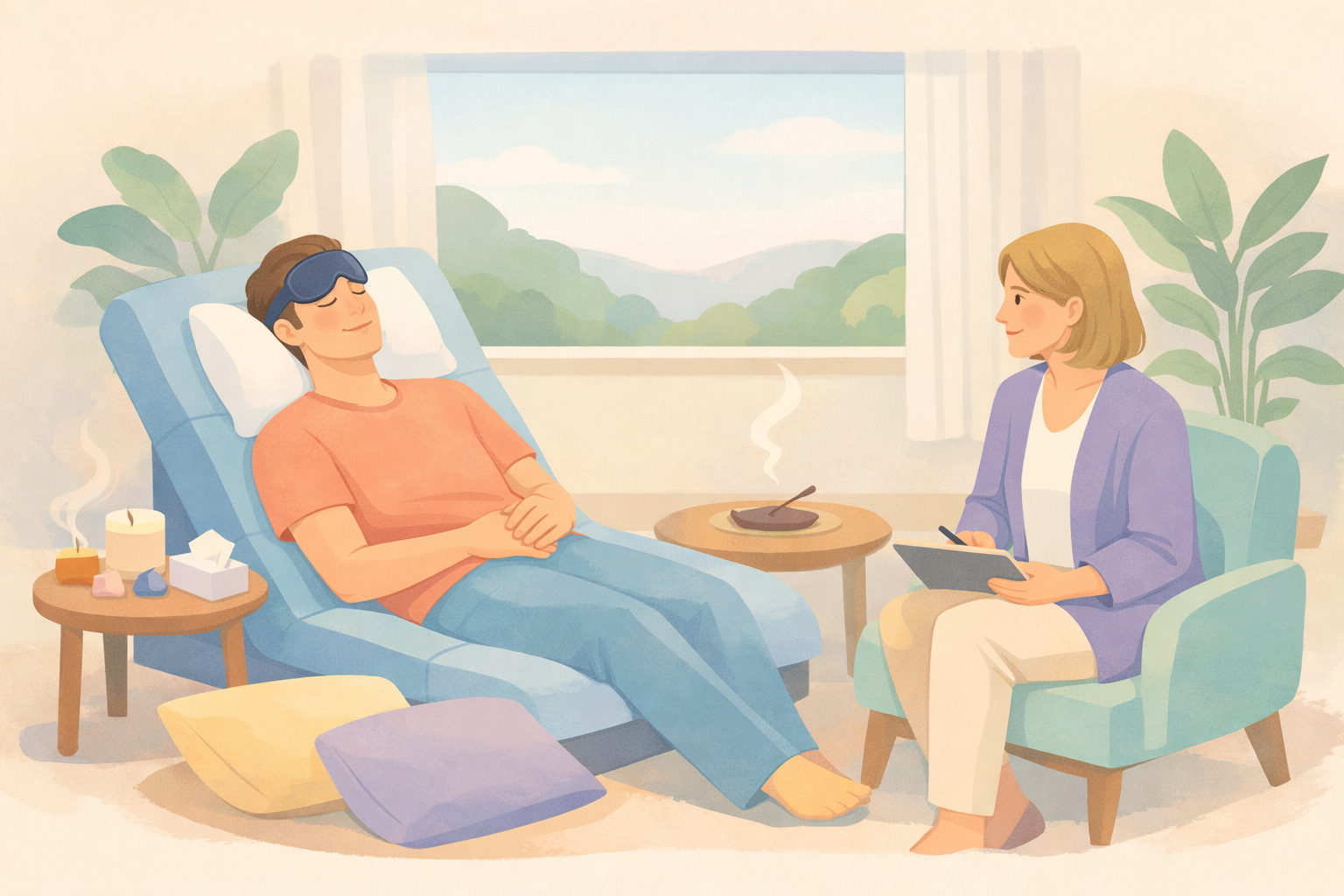
Instead of consuming magic mushrooms on your own, at home, you can embark on your psychedelic journey in a curated and supportive environment under the supervision of professionals over the course of several days to a week.
Psilocybin Retreats: Legal & Geographic Considerations
Psilocybin retreats are not widely accessible. At least, you can’t find them in every city or even every country. Some nations impose stricter laws on personal and commercial psychedelic use than others. Local cultural tendencies play a role, too.
Psilocybin retreats are commonly hosted in Central American or Caribbean countries like Jamaica, where it is decriminalized or fully legal, in certain European countries such as the Netherlands, and parts of the United States, where state legislatures have granted exemptions (psilocybin is federally illegal in the U.S.)

It’s equally important to understand the distinctions between legal, decriminalized, and unregulated. Psilocybin technically has legal status in Jamaica, meaning retreats can operate (though they’re not regulated by the government); in Oregon, U.S., legislators have created a licensing system to enable limited therapeutic access. However, possession of psilocybin is still legal at the state level.
Decriminalized drugs are still illegal to sell, but enforcement procedures are generally more relaxed regarding possession and consumption - though consequences are still on the table.
Psilocybin Retreats: How To Evaluate Programs & Facilitators
Unfortunately, there’s a good amount of grift in the health & wellness industry. Data from clinical trials suggest that psilocybin has legitimate medical utility and, to some, mystical properties. This broad appeal attracts legitimate facilitators and charlatans alike.
When looking for a psilocybin retreat, you need to know how to screen any individual or organization you’re thinking of working with.
Facilitator Experience & Training
A good psilocybin retreat will boast a robust and diverse staff of experts. Some providers come from traditional medical backgrounds in fields like psychiatry and neuroscience. Look for staff with extensive background experience in psychedelics, especially those who began their careers in associated fields.
Medical & Therapeutic Support
Retreat staff should conduct thorough background screenings before you get started, as well as having standard first-aid training, harm reduction, and crisis intervention experience. If you’re being encouraged to “dive right in” without laying groundwork beforehand, you’ll want to steer clear.
Pre-Screening Systems
Psilocybin is regarded as generally safe to consume in appropriate dosages and under supervision, but it’s not appropriate for everyone. Prior to entering a retreat, the staff should conduct a rigorous background check of your medical history, current or prior medications, general family history, and the like.

Good facilitators, on-site staff who steward and monitor the trip, will also take the time to discuss your “why” - the reasons and motivations behind your seeking a psilocybin retreat in the first place. Understanding your purpose helps staff shepherd you along the way. If you aren’t being asked about your mentality and perspective beforehand, you might be in the wrong place.
Preparation and Integration Support
Psilocybin trips can last several hours, but can also have residual effects lasting weeks to, potentially, indefinitely - if you nail your integration. Integration is a collection of practices and behaviors meant to help you mold the raw emotional material you dug up during the trip into something productive and practical.
At a psilocybin retreat, you’ll likely integrate under the guidance of a facilitator using one or more of methods like:
- Individual or group therapy
- Art and music sessions
- Journaling
- Meditation
- Immersion in nature
These activities capitalize on what science calls the psychedelic “afterglow” - a temporary period of heightened mental acuity unlocked by psilocybin.

Pre-screens and goal setting are important. But integration has been shown to be potentially impactful for a gainful psychedelic retreat experience. Without it, you may not walk away with much more than a good time.
Psilocybin Retreats: Red Flags To Avoid
You should feel safe, secure, and cared for at a psilocybin retreat. Many organizations take their mission seriously. Some are simply trying to pluck money from your pocket as fast as possible.
When it comes to psilocybin retreat red flags, there are a few major potential pitfalls to be mindful of:
Lack of Transparency
Retreats should clearly outline their policies in full and have everything formally established on paper, including consent forms and medical releases. Vagueness or ambiguity in language are red flags.
Poor or No Screening
No reputable retreat will let you take psilocybin without conducting some form of pre-screen. Avoid retreats or facilitators that don’t ask for medical history, medications you’re taking, your psychiatric history, etc. Blanket approval in all cases is a red flag for psilocybin retreats.
Other Warning Signs
- Lack of a personalized experience
- Identical dosing protocols for all users
- Poor staff-to-guest ratio (no more than five guests per facilitator)
- Grandiose claims of being a “cure-all”
- Excessive isolation or fostering integrative dependence
In plain English, a dangerous or disreputable psilocybin retreat won’t put your needs above their profits. It may seem unintuitive, but a tediously thorough intake process is a good sign, too. Psilocybin has tremendous clinical (and existential) potential - but there’s work to be done on both sides. Steer clear of anyone, or any group, who tells you they’ve got a shortcut.
Frequently Asked Questions
Sources
- Davis AK, Barrett FS, May DG, Cosimano MP, Sepeda ND, Johnson MW, Finan PH, Griffiths RR. Effects of Psilocybin-Assisted Therapy on Major Depressive Disorder: A Randomized Clinical Trial. JAMA Psychiatry. 2021 May 1;78(5):481-489. doi: 10.1001/jamapsychiatry.2020.3285. Erratum in: JAMA Psychiatry. 2021 Feb 10;78(5):569. doi: 10.1001/jamapsychiatry.2020.4714. PMID: 33146667; PMCID: PMC7643046.
- Goel DB, Zilate S. Potential Therapeutic Effects of Psilocybin: A Systematic Review. Cureus. 2022 Oct 12;14(10):e30214. doi: 10.7759/cureus.30214. PMID: 36381758; PMCID: PMC9650681.
- Goodwin GM, Aaronson ST, Alvarez O, Arden PC, Baker A, Bennett JC, Bird C, Blom RE, Brennan C, Brusch D, Burke L, Campbell-Coker K, Carhart-Harris R, Cattell J, Daniel A, DeBattista C, Dunlop BW, Eisen K, Feifel D, Forbes M, Haumann HM, Hellerstein DJ, Hoppe AI, Husain MI, Jelen LA, Kamphuis J, Kawasaki J, Kelly JR, Key RE, Kishon R, Knatz Peck S, Knight G, Koolen MHB, Lean M, Licht RW, Maples-Keller JL, Mars J, Marwood L, McElhiney MC, Miller TL, Mirow A, Mistry S, Mletzko-Crowe T, Modlin LN, Nielsen RE, Nielson EM, Offerhaus SR, O'Keane V, Páleníček T, Printz D, Rademaker MC, van Reemst A, Reinholdt F, Repantis D, Rucker J, Rudow S, Ruffell S, Rush AJ, Schoevers RA, Seynaeve M, Shao S, Soares JC, Somers M, Stansfield SC, Sterling D, Strockis A, Tsai J, Visser L, Wahba M, Williams S, Young AH, Ywema P, Zisook S, Malievskaia E. Single-Dose Psilocybin for a Treatment-Resistant Episode of Major Depression. N Engl J Med. 2022 Nov 3;387(18):1637-1648. doi: 10.1056/NEJMoa2206443. PMID: 36322843.
- Yu CL, Yang FC, Yang SN, Tseng PT, Stubbs B, Yeh TC, Hsu CW, Li DJ, Liang CS. Psilocybin for End-of-Life Anxiety Symptoms: A Systematic Review and Meta-Analysis. Psychiatry Investig. 2021 Oct;18(10):958-967. doi: 10.30773/pi.2021.0209. Epub 2021 Oct 8. PMID: 34619818; PMCID: PMC8542741.
- Haijen ECHM, Hurks PPM, Kuypers KPC. Effects of psychedelic microdosing versus conventional ADHD medication use on emotion regulation, empathy, and ADHD symptoms in adults with severe ADHD symptoms: A naturalistic prospective comparison study. Eur Psychiatry. 2024 Feb 14;67(1):e18. doi: 10.1192/j.eurpsy.2024.8. PMID: 38351594; PMCID: PMC10966614.
- Modlin NL, Williamson V, Maggio C, Stubley J, Kirlic N, Cleare A, Rucker J. Clinical conceptualisation of PTSD in psilocybin treatment: disrupting a pre-determined and over-determined maladaptive interpretive framework. Ther Adv Psychopharmacol. 2025 Jun 8;15:20451253251342319. doi: 10.1177/20451253251342319. PMID: 40492108; PMCID: PMC12146596.
- Johnson MW, Garcia-Romeu A, Griffiths RR. Long-term follow-up of psilocybin-facilitated smoking cessation. Am J Drug Alcohol Abuse. 2017 Jan;43(1):55-60. doi: 10.3109/00952990.2016.1170135. Epub 2016 Jul 21. Erratum in: Am J Drug Alcohol Abuse. 2017 Jan;43(1):127. doi: 10.1080/00952990.2016.1277105. PMID: 27441452; PMCID: PMC5641975.
- Evens R, Schmidt ME, Majić T, Schmidt TT. The psychedelic afterglow phenomenon: a systematic review of subacute effects of classic serotonergic psychedelics. Ther Adv Psychopharmacol. 2023 May 29;13:20451253231172254. doi: 10.1177/20451253231172254. PMID: 37284524; PMCID: PMC10240558.
- Bathje GJ, Majeski E, Kudowor M. Psychedelic integration: An analysis of the concept and its practice. Front Psychol. 2022 Aug 4;13:824077. doi: 10.3389/fpsyg.2022.824077. PMID: 35992410; PMCID: PMC9386447.
Before you apply
Beckley runs legal, guided psilocybin retreats in Jamaica and psilocybin retreats in the Netherlands: four weeks of preparation, two guided sessions on retreat, six weeks of integration, online and at your own pace, one to two hours a week. Plain answers to the questions people ask first:
What a psilocybin retreat costs · What happens, day by day · Jamaica or the Netherlands · Who should not attend · Apply