-2-1.png)



For many, the most meaningful insights of a psychedelic journey emerge slowly, revealing themselves in the days, weeks, and sometimes months after the ceremony ends. For the vast majority, you return home with sharpened clarity, softer defences, and a renewed sense of possibility. Yet you also step back into a world that has not changed with you. Your inbox is overflowing, your relationships need tending, and your old habits are waiting to draw you back into familiar rhythms.
Psychedelic integration is documented in the scientific literature as a state of emotional sensitivity, neural flexibility, and behavioural openness that is unusually high. And anyone who has attended a retreat will recognize this feeling of their internal feelings conflicting with their outward reality. Routines that once played out automatically can suddenly feel misaligned. Conversations that used to flow now require more conscious effort. Your inner world is still recalibrating while the outer world moves on as if nothing has happened.

Staff at Beckley Retreats often describe the sensation immediately after a retreat as being like a ‘peeled orange’ – tender, unarmoured, newly exposed. Having shed the protective layers you spent years constructing, the everyday world can feel abrasive. It’s a powerful but vulnerable window, and navigating it alone can be difficult. This is where an integration therapist steps in.
What Is an Integration Therapist?
An integration therapist is a mental health professional trained specifically to help people make sense of non-ordinary states of consciousness (NOSC) – states reached through meditation, breathwork, psychedelic substances, or deep spiritual work.
They don’t necessarily provide psychedelic substances or encourage their use; they act as a guide to help you translate the abstract, emotional, or visionary material of a retreat into sustainable life changes.
A standard therapist is typically trained to focus on pathology, including symptoms, diagnoses, coping strategies, and long-term emotional patterns. This work is valuable; however, it’s not the same thing as integration work. Integration therapy is meaning-making work. It’s the bridge between your psychedelic experience and your behaviour.
Standard Therapy vs. Integration Therapy
| Standard Therapist | Integration Therapist |
|---|---|
| Focuses on symptoms, diagnoses, and long-term emotional patterns | Focuses on interpreting and grounding non-ordinary experiences |
| Works within a traditional clinical frame | Uses frameworks from psychology, spirituality, and neuroscience |
| May lack training in psychedelic experiences and may pathologise them | Normalises and contextualises visionary states and altered perception |
| Supports ongoing mental health | Supports a specific post-retreat window of change and growth |
| Often long-term | Often short-term, targeted support |
You don’t need to stop seeing your regular therapist, but if you’re embarking on a psychedelic journey, you should always enquire about an integration specialist who understands the post-experience process.
The Neuroplastic Window: Why Timing Matters
Coming back from a psychedelic retreat can feel like stepping out of a fog and suddenly seeing the world in sharper focus. This is what researchers call a “neuroplastic window,” a period during which the brain’s Default Mode Network – the network of interconnected brain regions tied to internal thoughts, memory, and self-reflection – is more malleable. It’s during this window that people can start to form new behaviours and solve existing problems in new ways.
But this window doesn’t stay open for long – typically just a few days or weeks – and without careful integration, old habits creep back, familiar thoughts reassert themselves, and the mind slowly hardens again. Integration is what transforms fleeting insight into meaningful, lasting change.
Indigenous traditions offer compelling models for navigating this window. Among the Mazatec people of Oaxaca, Mexico, psilocybin mushrooms are taken under the guidance of a curandero, or healer. After the visionary experience, participants engage in quiet reflection, dialogue, and ritual offerings.
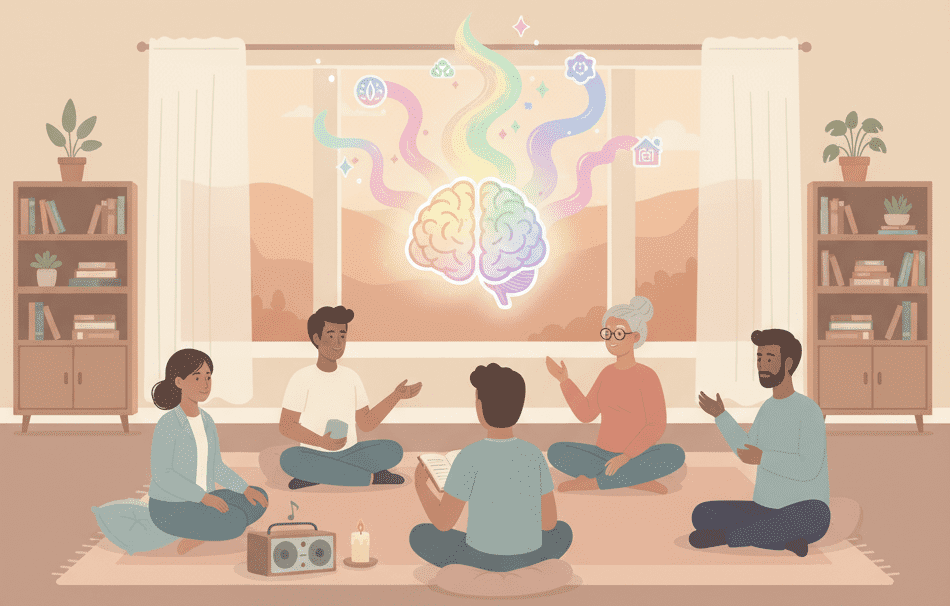
An integration therapist plays a similar role for Western participants, helping to shape that malleable mind, translating revelations into daily life, and ensuring the glow of insight doesn’t fade into memory. The retreat opens the door, but integration is what lets you step through.
Three Signs You Might Need an Integration Therapist
You’re Using the “Afterglow” to Ignore Problems
It’s common to return from a retreat with a deep sense of peace and declare that your problems no longer matter, except they do. Avoiding your actual life, such as your responsibilities, relationships, boundaries, or health, all under the guise of “staying in the light” can be detrimental to your overall well-being.
Without integration, you’ll likely feel the ‘afterglow’ of enhanced emotions and clarity for weeks following the experience, but you won’t have the tools to transform these into long-term change.
You Feel Alienated From Your “Old Life”
This is especially common after a profound or mystical experience. You may look at your job, friendships, or habits and think: None of this fits anymore. What now?
If you don’t have the right support, this can lead to isolation or impulsive life overhauls that feel profound in the moment but aren’t rooted in any sensible long-term plan. Integration therapy offers a steady middle path by honouring what’s changing without burning your entire life down.
You’re Overwhelmed by Insights
Many people come back with entire notebooks of revelations with sudden clarity about childhood patterns and a renewed sense of purpose.

But which insight comes first? What is actionable? What belongs to the subconscious processing itself? A trained integration therapist helps you:
- Prioritize insights
- Identify what’s real vs. symbolic
- Map out your next steps
- Build micro habits that make the change stick
It’s not about chasing peak experiences but about restructuring your life, so the insight is lived, not lost.
How Beckley Approaches Integration
Beckley Retreats embeds integration directly into the program, treating it not as an optional add-on but as the backbone of the journey. The experience is divided into three phases:
- Prepare: establishing grounding, intention, and psychological safety
- Experience: the retreat itself
- Integrate: six weeks of guided support, workshops, and connection.
Your Beckley Retreats Coach works alongside you throughout the integration phase, helping translate the experience into practical, lasting change. This may include making meaning of your journey, anchoring fleeting sensations with somatic recall practices, and embedding supportive skills such as mindfulness, self-reflection, or boundary-setting into daily routines. Coaches also help troubleshoot obstacles, foster ongoing self-discovery, and reintegrate insights into relationships, work, and community life.
As Kosu Boudreau, a Beckley integration specialist, explains: “These experiences open a portal. But the question is – what do we do with that opening?”
The real transformation begins here. Integration at Beckley is about rekindling purpose, cultivating deeper empathy, and harmonizing who you’ve become with the life you return to. The peak moment may feel expansive, but the invitation is to let it shape the way you move through the world.
Frequently Asked Questions
Sources
- What Therapists Need to Know About Psychedelic Integration – Multidisciplinary Association for Psychedelic Studies – MAPS. Maps.org. Published 2025. Accessed December 11, 2025. https://maps.org/integration/what-therapists-need-to-know-about-psychedelic-integration/
- Study Shows Psychedelic Drugs Reopen “Critical Periods” for Social Learning. www.hopkinsmedicine.org. https://www.hopkinsmedicine.org/news/newsroom/news-releases/2023/06/study-shows-psychedelic-drugs-reopen-critical-periods-for-social-learning
- Ronit Kishon, Cycowicz YM. Psychedelic therapy: bridging neuroplasticity, phenomenology, and clinical outcomes. Frontiers in Psychiatry. 2025;16. doi:https://doi.org/10.3389/fpsyt.2025.1637162
- Bathje GJ, Majeski E, Kudowor M. Psychedelic integration: An analysis of the concept and its practice. Frontiers in Psychology. 2022;13. doi:https://doi.org/10.3389/fpsyg.2022.824077
- Nguyen J. Psychedelic Assisted Therapy vs. Psychedelic Integration. Psychedelic Passage. Published July 25, 2020. https://www.psychedelicpassage.com/psychedelic-assisted-therapy-vs-psychedelic-integration/