-2-1.png)


Though they’re not new, but psychedelic drugs, used both in a clinics and at retreats, have become a more accepted and popular way for people to reduce their stress, assess specific situations with a new mindset, and even help ease cases of depression, anxiety, and PTSD.
If you’re reading this article, you’ve likely concluded that you’re set on or highly interested in trying a psychedelic retreat, and that Portugal – maybe because you live there or have read about its progressive drug policies – is the country you’d like to have that experience. The (not-so) spoiler is this: Portugal has progressive and lenient drug laws that make different psychedelic retreats accessible. But before you commit, it’s crucial to understand the nuances of that statement, as well as what to look for in a retreat. Just because they’re available doesn’t mean they’re done well.
Can Psychedelic Retreats Help with Stress?
Yes. The World Health Organization (WHO) defines stress as “a state of worry or mental tension caused by a difficult situation.” It’s a vague term, and essential to consult with a licensed medical professional to understand the source of your stress. Maybe you require non-psychedelic treatment, or perhaps a retreat is a good option for you. Ensure you know the root cause of your symptoms before attempting to address them.
That said, there’s a growing body of research about how different psychedelics can ease the symptoms of stress.
One systematic review of five studies found that the patients who took psilocybin, the psychedelic drug found in many species of so-called ‘magic’ mushrooms, experienced a “significant and sustained” reduction in symptoms of anxiety and depression, and that those changes took effect immediately and lasted up to six months. Another review found that combat veterans, when supported by PAP, was effective in helping them, though the authors stated they reviewed a small body of literature, and more research was warranted.

Recent clinical trials showed that a form of LSD elicited a dose-dependent reduction in anxiety. Ketamine – used mainly as a general anesthetic – can reduce anxiety symptoms, and MDMA (aka ecstasy) significantly reduced PTSD symptoms when paired with therapy compared to participants who took the placebo plus therapy.
How They Help
These psychedelics have different mechanisms, but the long and short of it is that, in some capacity, they alter brain functioning, thought to quiet the region of your brain that’s active during daydreaming, self-reflection, and memory. And the thought is that changing your brain function temporarily allows you to approach existing situations or problems with a new perspective and line of thinking.
The post-experience phase is called “integration”, a period of reflection where journaling, group discussion, and even working with an integration therapist help you make sense of your journey and translate your self-discovery into real-life action. Often times, integration is thought to be an important part of helping those insights stick.
Basically, the drugs help you open your mind so you can discover new feelings or perspectives about an aspect of your life, and the post-retreat integration process is where you turn those realizations into actionable steps that can improve your life.
Portugal’s Psychedelic Landscape
In 2001, Portugal decriminalized all drugs for personal use, removing criminal penalties for small quantities. Decriminalization isn’t the same as legalization, but, practically, it means there’s a legal grey area where small amounts aren’t a priority for law enforcement agencies. If you’re caught with a small amount, you won’t face any jail time. However, drug trafficking, dealing, and possession of large quantities remain criminal offenses. Basically, this creates a low-risk atmosphere where people feel comfortable responsibly taking drugs.
For those seeking unregulated or legal jurisdictions, both Jamaica (unregulated) and the Netherlands (legal in the form of truffles) permit the use of psilocybin for wellness purposes. These countries offer the same therapeutic potential without legal ambiguity.
The 3 Phrases of a Retreat
When choosing a retreat, focus on three key phases of the process: preparation, immersion, and integration. A safe and effective retreat tends to have a comprehensive and transparent approach to all three of these steps. Let’s quickly break them down.
Preparation
The first thing you should do is a health screening to identify and disqualifying physical or mental traits — such as cardiovascular conditions, psychosis, and medication interactions (especially SSRIs).
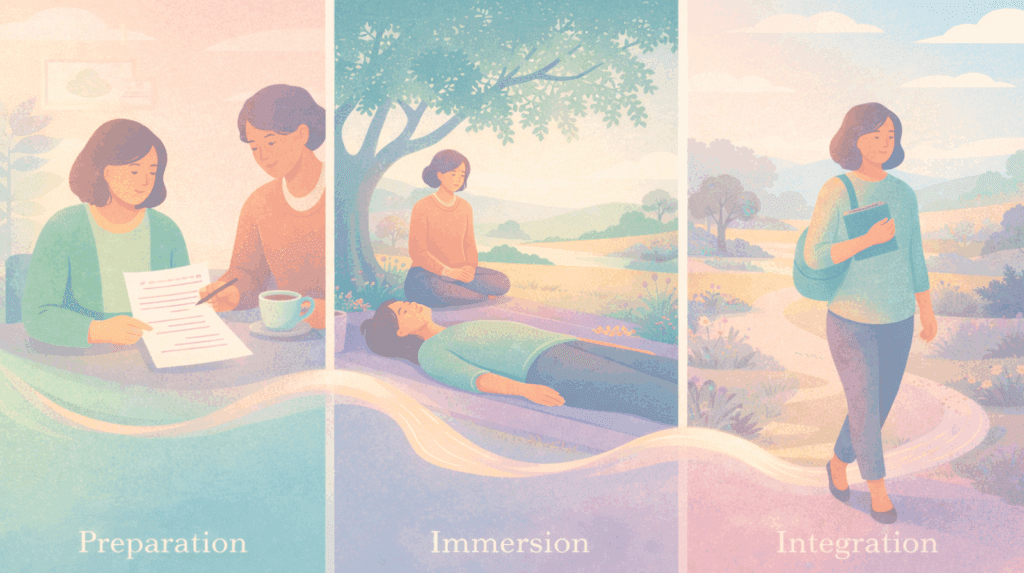
From there, you’ll do pre-retreat work to establish a productive mindset (referred to in the psychedelic community as your “set”). Certain retreats may pair you with a facilitator or simply send you prep materials. Either way, expect that work to include clarifying intentions, practicing meditation or breathwork, addressing medical contraindications, and building trust with facilitators.
Immersion
The immersion phase is the retreat itself. The length of a retreat varies by the type of drug you’re taking and where it’s being held, but expect to be at the retreat for three days to a week. Most retreat companies put a lot of effort into creating a safe and soothing environment since one’s “setting” has also been shown to impact the psychedelic experience itself. Typically, you’ll be immersed in nature, with comfortable but minimal accommodations and three healthy meals served to you.
There is typically a ceremony for when you ingest the actual drug, which is led by a facilitator and supervised by a handful of others. There should be, and usually are, medical staff on hand in case of an emergency.
Integration
Integration is where lasting transformation happens. Psychedelic integration means incorporating insights into daily life through practices like journaling, psychotherapy, meditation, and lifestyle adjustments. Well-structured programs emphasize a three-phase model with support continuing for six weeks after the retreat. This ongoing guidance helps translate profound experiences into sustainable change.
Choosing a Retreat in Portugal (or Elsewhere)
When evaluating providers, prioritize transparency and credentials. Look for clear medical screening processes, trained facilitators with mental health backgrounds, and detailed emergency protocols. Red flags include promises of specific outcomes, lack of preparation requirements, vague information about facilitator qualifications, or pressure tactics.
Reputable programs provide detailed information about their approach, facilitate pre-retreat consultations, and maintain reasonable participant-to-facilitator ratios – typically no more than four participants per facilitator during ceremonies.

Before committing, ask about facilitator training and credentials, participant screening processes, medical support availability, integration offerings, and how they handle difficult experiences. Request references from previous participants and clarify what happens if legal issues arise. Inquire specifically about the legal status of their operations and what protections exist for participants. Transparent providers will address these questions directly.
Why Legal, Structured Programs Matter
Guided sessions with psychological support produce significantly better outcomes than unstructured use. Multi-day retreat formats allow for gradual preparation, ceremony, and initial integration before returning to daily life.
While Portugal’s enforcement is minimal, there’s no regulatory oversight ensuring facilitator training or safety protocols. Programs rooted in decades of research offer evidence-informed approaches that maximize safety and efficacy.
For those prioritizing legal compliance and medical oversight, programs operating in fully legal jurisdictions offer peace of mind alongside trained facilitators, comprehensive medical screening, and structured integration support. While Portugal offers natural beauty and progressive attitudes, legally operating programs provide regulatory oversight and the certainty that comes with full compliance.
Frequently Asked Questions
Are psychedelic retreats legal in Portugal?
Psilocybin possession for personal use is decriminalized but not legal in Portugal, creating a gray area where retreats operate without explicit authorization yet face minimal enforcement. Participants assume some legal risk, though prosecutions targeting retreat attendees are rare. Legal alternatives exist in Jamaica and the Netherlands.
How does psilocybin reduce stress and anxiety?
They disrupt your existing neural patterns to promote what’s called neuroplasticity which helps your brain form new patterns. Simply put, they alter your mindset so you can think in new ways about the root cause(s) of your stress.
Who shouldn’t attend a psychedelic retreat?
Individuals with personal or family history of psychosis, bipolar disorder, active suicidal ideation, uncontrolled cardiovascular conditions, or those taking certain medications should avoid psilocybin. Pregnancy and breastfeeding are also contraindications. Always consult with qualified healthcare providers before considering psychedelic-assisted experiences.
References
- Ishak, Waguih W., Patricia Garcia, Ryan Pearl, et al. “The Impact of Psilocybin on Patients Experiencing Psychiatric Symptoms: A Systematic Review of Randomized Clinical Trials.” Innovations in Clinical Neuroscience, vol. 20, nos. 4–6, 2023, pp. 39–48.
- Khan, A. J., Emily Bradley, Aoife O’Donovan, and Joshua Woolley. “Psilocybin for Trauma-Related Disorders.” Current Topics in Behavioral Neurosciences, vol. 56, 2022, pp. 319–332. Springer, doi:10.1007/7854_2022_366.
- Robison, R., R. Barrow, C. Conant, et al. “Single Treatment With MM120 (Lysergide) in Generalized Anxiety Disorder: A Randomized Clinical Trial.” JAMA, vol. 334, no. 15, 21 Oct. 2025, pp. 1358–1372, doi:10.1001/jama.2025.13481.
- Walsh, Zachary, Omer Mollaahmetoglu, Joanna Rootman, et al. “Ketamine for the Treatment of Mental Health and Substance Use Disorders: A Comprehensive Systematic Review.” BJPsych Open, vol. 8, no. 1, 2021, article e19, doi:10.1192/bjo.2021.1061.
- Mitchell, Jennifer M., et al. “MDMA-Assisted Therapy for Moderate to Severe PTSD: A Randomized, Placebo-Controlled Phase 3 Trial.” Nature Medicine, vol. 29, 2023, pp. 1–8, doi:10.1038/s41591-023-02565-4.
- Bathje, Geoff J., Emily Majeski, and Michael Kudowor. “Psychedelic Integration: An Analysis of the Concept and Its Practice.” Frontiers in Psychology, vol. 13, 2022, doi:10.3389/fpsyg.2022.824077.