
-2-1.png)

There’s a reason that psychedelic trips are often called journeys. Some substances come on and dissipate quickly - certain psychedelics, like psilocybin, tend to come with much longer timelines of effects.
What’s more, psilocybin’s psychological effects persist long after you come down from your trip. It’s that extended off-ramp period that holds promise for creating meaningful change. But if you’re thinking of having your first psychedelic experience with psilocybin, or you’re considering booking a psychedelic retreat, you need to have an accurate sense of the drug’s timeline.
The Timeline of a Psilocybin Experience
Psilocybin is likely the most popular classical psychedelic in the world. “Magic mushrooms” have been utilized in cultural ceremonies and rituals for hundreds of years. More recently, psychedelic-assisted therapies (PAT) have received renewed clinical attention as potential alternative treatments for stubborn mental illnesses.
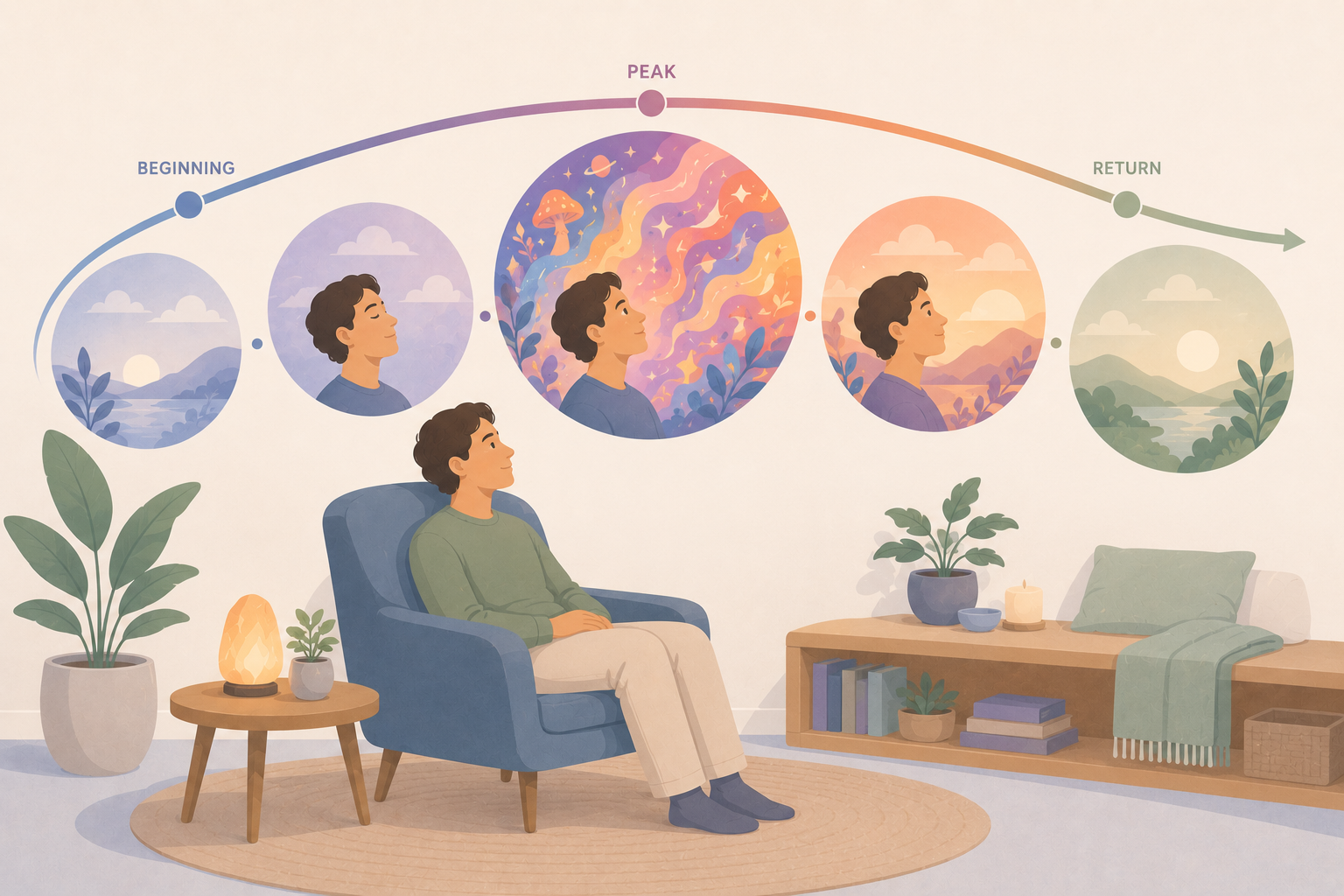
The result? A rapidly growing interest in trying psychedelics If you fall into that camp, here’s a timeline of psilocybin effects, from onset to off-ramp:
Quick Facts
- Total Duration: 4-6 hours
- Onset: Within 20-60 minutes
- Effects Peak: Within 2-4 hours
Researchers have closely studied psilocybin’s effect timeline. Once ingested, psilocybin is converted into psilocin which interacts with specific receptors in your brain. Timeline data tell us that maximum psilocin conversion and uptake occur between two and three hours after ingestion.
- Most people report the highest subjective intensity scores - how hard the mushrooms are hitting - around an hour or two after ingestion.
- These peak effects can remain for another hour or so, then sharply recede.
- Six hours after ingestion, most people report returning to baseline lucidity.
Psilocybin Effect Timeline: What Each Phase Feels Like
Caffeine is a drug. So are psychedelics. But among their many differences is subjectivity - where caffeine comes on quickly and affects most people the same way, the effects of psilocybin are highly subjective and idiosyncratic.
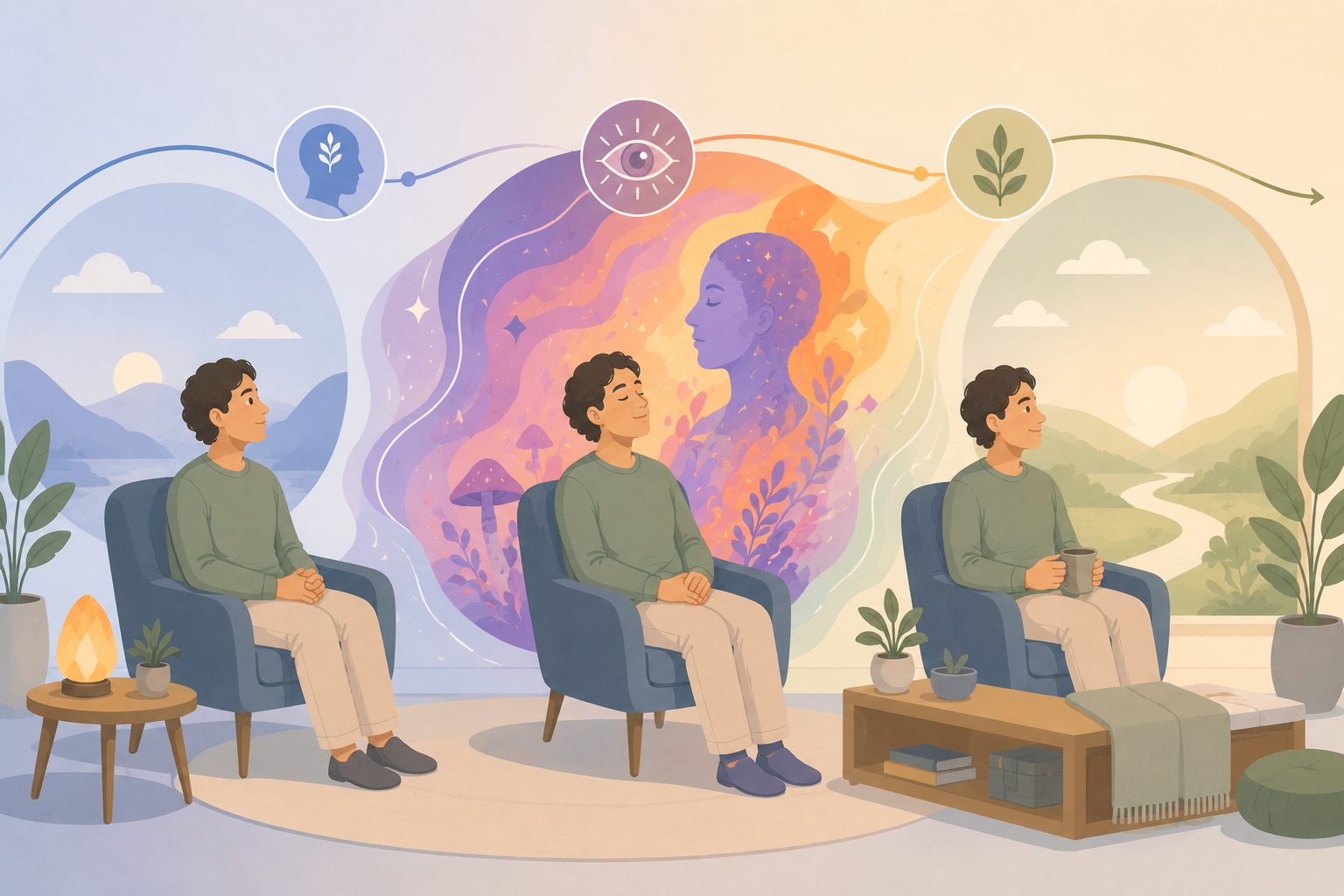
Your journey with psilocybin won’t feel like anyone else’s, and seems to depend a great deal on the mindset you carry into the experience (we’ll get to that), in addition to the setting you find yourself in. Still, we do have some reliable clinical data on common sensations over the time course of a psilocybin experience.
Phase 1: The Come-Up
Psilocybin has risks. Most people experience negative physical sensations like nausea, a rolling stomach, or lethargy during the onset of the psilocybin timeline. You may also feel antsy, restless, or anxious.

Participants in psilocybin case studies describe this phase as “waves of electric energy … lightheadedness, spacing out …” along with an “anticipatory” emotional climate.
Phase 2: Peak Effects
Once the psilocybin has taken hold in your brain, the peak effects of the drug may evoke a mystical experience. This is where maximum personal detachment and ego-dissolution - one of the mechanisms believed to be responsible for psilocybin’s long-term efficacy - take place.

Physically, you’ll feel floaty or even detached from your body. Time may seem to slow to a crawl, or disentangle altogether. During psilocybin’s peak effects, psychedelic facilitators may gently nudge or prompt you based on your behavior, but this period of the voyage is an autonomous journey you must navigate yourself.
Phase 3: The Comedown
The comedown period of psilocybin is surprisingly serene for many people, despite the acute effects subsiding much more quickly than they came on. Researchers summarize this period as having a “predominance of calm, positive emotions.”
Depending on the nature of your voyage during peak effects, you may land with the perspective of having returned from a challenging journey. As you regain lucidity, you may find yourself keenly aware of your environment.

One study participant remarked, “I [felt anew] … sunrays bathed everything in a golden, friendly light … it was miraculous, but I also got quite emotional … I was filled with a strong sense of gratitude.”
Psilocybin Effect Timeline: Mental Changes
For those using psilocybin as a mental health intervention or explorative personal journey, it’s the period after the trip that matters most. You can think of using psilocybin as a farmer tilling soil - laborious and disruptive, but setting the stage for something new to grow and sprout if appropriately tended to.
The mechanism at play here involves what researchers have dubbed the psychedelic “afterglow”: a period of elevated neurological sensitivity to change. To the user, it can feel quite literal, like they’re basking in the glow of the drug itself. Users report that this afterglow phenomenon plays host to “potentially beneficial changes in the perception of self” among broader shifts in emotional climate.
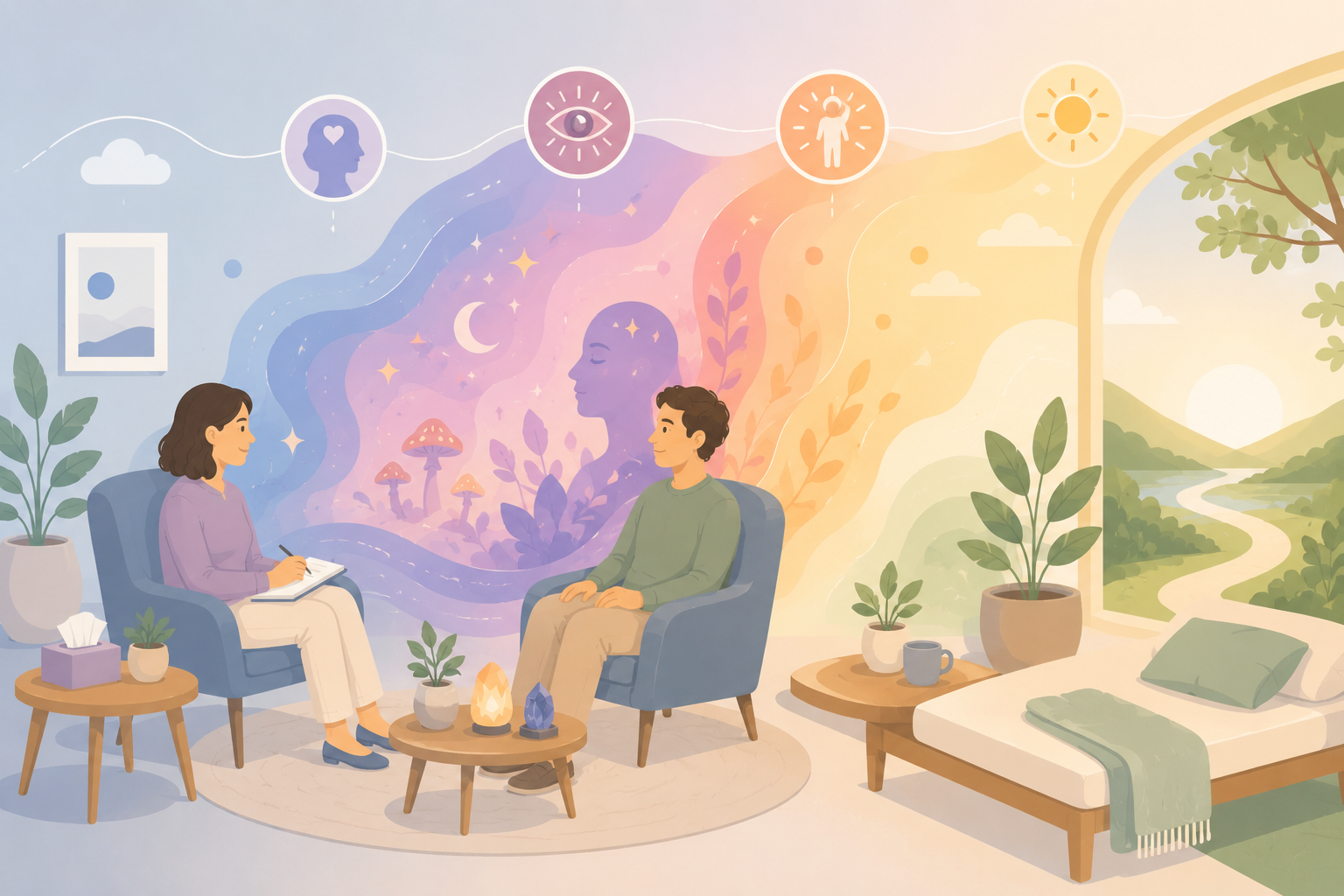
Practically speaking, you may feel like your mental slate has shifted or been wiped clean. However, psilocybin isn’t a one-and-done mental revamp. Research emphasizes the apparent value of utilizing psychedelic integration techniques to solidify the mental changes before they dissipate.
When undertaken properly, studies tell us that psilocybin can create meaningful change that persists months after ingestion. This distinction is critical: Psilocybin is not aspirin. Your intent and mindset play a role, and even with proper preparation, things may spiral out of control.
How Long Psilocybin Stays in the Body
Psilocybin effect timelines vary, as does the duration the drug stays in your body. Broadly speaking, psilocin has a half-life of 1.5 to 4 hours. A common rule of thumb is that five half-life cycles eliminate the majority of a drug - psilocin should clear your system in a day or two.

However, that window generally applies to urine, blood, and saliva tests. Detectable psilocybin may persist in your hair or nails, in trace amounts, for weeks to months, long after you stop feeling anything consciously.
Factors That Affect Duration
Like any drug, psilocybin’s effects (and side effects) are dose-dependent. But circumstantial factors can affect both the psilocybin effect duration and how long it remains in your system:
- Dose: Higher doses produce stronger acute effects and may come on quicker.
- Metabolism: Body chemistry affects how efficiently psilocybin is metabolized and expelled
- Set & Setting: A turbulent environment, internally or externally, can extend an unpleasant off-ramp experience, or worsen perception of the drug coming on.
Frequently Asked Questions
Sources
- Nichols DE. Psilocybin: from ancient magic to modern medicine. J Antibiot (Tokyo). 2020 Oct;73(10):679-686. doi: 10.1038/s41429-020-0311-8. Epub 2020 May 12. PMID: 32398764.
- Yang KH, Satybaldiyeva N, Allen MR, Ayers JW, Leas EC. State Cannabis and Psychedelic Legislation and Microdosing Interest in the US. JAMA Health Forum. 2024;5(6):e241653. doi:10.1001/jamahealthforum.2024.1653
- Madsen MK, Fisher PM, Burmester D, Dyssegaard A, Stenbæk DS, Kristiansen S, Johansen SS, Lehel S, Linnet K, Svarer C, Erritzoe D, Ozenne B, Knudsen GM. Psychedelic effects of psilocybin correlate with serotonin 2A receptor occupancy and plasma psilocin levels. Neuropsychopharmacology. 2019 Jun;44(7):1328-1334. doi: 10.1038/s41386-019-0324-9. Epub 2019 Jan 26. Erratum in: Neuropsychopharmacology. 2019 Jun;44(7):1336-1337. doi: 10.1038/s41386-019-0360-5. PMID: 30685771; PMCID: PMC6785028.
- Madsen, M. K., Fisher, P. M., Burmester, D., Dyssegaard, A., Stenbæk, D. S., Kristiansen, S., Johansen, S. S., Lehel, S., Linnet, K., Svarer, C., Erritzoe, D., Ozenne, B., & Knudsen, G. M. (2019). Psychedelic effects of psilocybin correlate with serotonin 2A receptor occupancy and plasma psilocin levels. Neuropsychopharmacology, 44(7), 1328–1334.
- Brouwer, A., Brown, J.K., Erowid, E. et al. A qualitative analysis of the psychedelic mushroom come-up and come-down. npj Mental Health Res 4, 6 (2025). https://doi.org/10.1038/s44184-024-00095-6
- Griffiths, R.R., Richards, W.A., McCann, U. et al. Psilocybin can occasion mystical-type experiences having substantial and sustained personal meaning and spiritual significance. Psychopharmacology 187, 268–283 (2006).
- Letheby C, Gerrans P. Self unbound: ego dissolution in psychedelic experience. Neurosci Conscious. 2017 Jun 30;2017(1):nix016. doi: 10.1093/nc/nix016. PMID: 30042848; PMCID: PMC6007152.
- Evens R, Schmidt ME, Majić T, Schmidt TT. The psychedelic afterglow phenomenon: a systematic review of subacute effects of classic serotonergic psychedelics. Ther Adv Psychopharmacol. 2023 May 29;13:20451253231172254. doi: 10.1177/20451253231172254. PMID: 37284524; PMCID: PMC10240558.
- Bathje GJ, Majeski E, Kudowor M. Psychedelic integration: An analysis of the concept and its practice. Front Psychol. 2022 Aug 4;13:824077. doi: 10.3389/fpsyg.2022.824077. PMID: 35992410; PMCID: PMC9386447.
- McCulloch DE, Madsen MK, Stenbæk DS, Kristiansen S, Ozenne B, Jensen PS, Knudsen GM, Fisher PM. Lasting effects of a single psilocybin dose on resting-state functional connectivity in healthy individuals. J Psychopharmacol. 2022 Jan;36(1):74-84. doi: 10.1177/02698811211026454. Epub 2021 Jun 30. PMID: 34189985; PMCID: PMC8801642.
- Meshkat S, Al-Shamali H, Perivolaris A, Tullu T, Zeifman RJ, Zhang Y, Burback L, Winkler O, Greenshaw A, Husain MI, C Reichelt A, Vermetten E, Jha MK, Jetly R, Loebenberg R, Bhat V. Pharmacokinetics of Psilocybin: A Systematic Review. Pharmaceutics. 2025 Mar 25;17(4):411. doi: 10.3390/pharmaceutics17040411. PMID: 40284409; PMCID: PMC12030428.
Before you apply
Beckley runs legal, guided psilocybin retreats in Jamaica and psilocybin retreats in the Netherlands: four weeks of preparation, two guided sessions on retreat, six weeks of integration, online and at your own pace, one to two hours a week. Plain answers to the questions people ask first:
What a psilocybin retreat costs · What happens, day by day · Jamaica or the Netherlands · Who should not attend · Apply