
The Mental Health Revolution: Unlocking the Benefits of Psilocybin and Functional Mushrooms
There’s a fungal renaissance happening in mental healthcare. For years, it’s felt like the solution to untangling conditions like depression or anxiety had to be pharmaceutical. But as science advances, emerging research is painting a different picture about the purpose (and potency) of mushrooms—both psychedelic and functional— for mental health.
Psychedelics have finally begun to shed their stigma as being medicine-adjacent or a trippy pastime. When it comes to mushrooms in particular, clinical breakthroughs and reputable institutions alike are singing the same tune: There are substantial mental health benefits to mushrooms, from treating chronic conditions like depression to sharpening cognition. Let’s break down what the science says about using fungi, from psilocybin to lion’s mane, to improve mental health.
Benefits of Mushrooms for Mental Health
“Magic mushrooms,” as you probably know them, are a type of psychedelic drug. For many years, research into psychedelics was stymied by political paranoia and misinformation. As that fog has lifted, we’re gaining a higher-resolution picture of the benefits of mushrooms for mental health.
A mechanism behind the impact? Neuroplasticity. It’s the brain’s ability to reformat itself, forming new connections between neurons and neural pathways, that influences how we view and engage with life (and the stressors that come with it). When a sufficient quantity of psilocybin is ingested, its psychedelic properties bolster neuroplasticity, creating a much-needed mental reset.
But not all mushrooms with mental health benefits are psychoactive. Other types of fungi, like lion’s mane or reishi, are regarded as “functional mushrooms.” Functional mushrooms won’t make you trip, but when microdosed regularly, they can provide subtle mental nourishment.
The potential mental health benefits of mushrooms vary depending on what kind and how much you take. Let’s get specific.
Psilocybin: The Breakthrough for Deep Psychological Healing
Psilocybin is what most people think of when they imagine taking mushrooms. In addition to being a good time, psilocybin may have remarkable mental health benefits, in part by suppressing the brain’s Default Mode Network, or DMN.
How Psilocybin Resets the Brain
Science has come to recognize the DMN as the “seat of the ego” in the brain. It’s a network that switches on when you don’t have specific external stimuli; think of it like a mental screensaver.
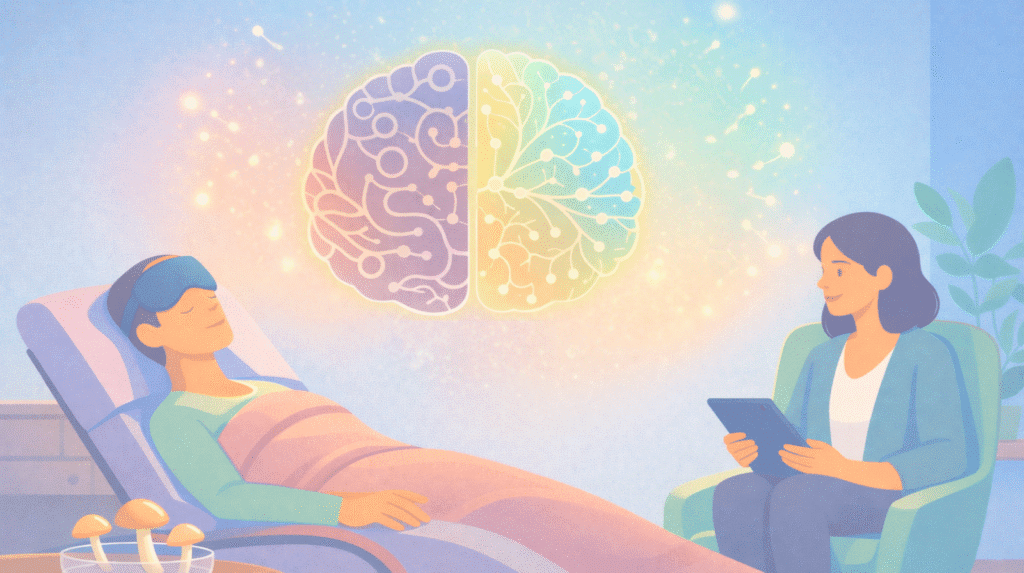
While active, the DMN encourages deep introspection and mind-wandering. Doesn’t sound too bad, right? Unfortunately, excessive DMN activity has also been associated with depressive symptoms – it locks your brain into repeated pattern recognition, calcifying your outlook.
Psilocybin has been shown to temporarily suppress the DMN, allowing disparate regions of your brain to connect and communicate, instead of locking you in the same whirlpool of negative thoughts.
Psilocybin Mental Health Benefits
- In 2020, researchers reported that psilocybin-assisted therapy can be “efficacious in treating major depressive disorder.”
- One study in 2023 found that a single 25mg dose of psilocybin led to a “clinically significant” sustained reduction in depressive symptoms.
Beyond the mental health benefits of mushrooms for common ailments like anxiety and depression, new research also highlights their potential in managing addiction and substance abuse. There appears to be a small beneficial effect, but more work is needed in this area.
Functional Mushrooms: Daily Support for Cognitive Health
Taking care of your health shouldn’t require you to move mountains; scheduling appointments or undergoing intensive therapies might be more than you need. If psilocybin is an avalanche, taking small doses of functional mushrooms for mental health, like lion’s mane,reishi, or cordyceps, is more akin to a slow, gradual snowfall.

These fungi are not psychoactive, meaning taking them regularly won’t disrupt your day-to-day. Instead, think of functional mushrooms as mental multivitamins – you don’t need to feel or see things to know they’re working.
Lion’s Mane
Lion’s mane, or Hericium erinaceus, is an edible mushroom commonly sourced from Asia. While it lacks the robust evidentiary support psilocybin has, the data we do have are quite compelling.
- In 2023, scientists tested the acute (one hour after) and chronic (one month later) effects of daily lion’s mane supplementation, taken as a pill, on cognition and mood.
- After just one dose, participants performed better on certain cognitive processing tests (and neutral or worse on others).
- After a month of daily dosing, participants reported “significantly lower” chronic stress levels.
So, what’s happening here? While we don’t yet know the specific mechanisms behind lion’s mane mushrooms for mental health, other works have shown how the fungi stimulates Nerve Growth Factor, or NGF, in the brain.
Recall the importance of neuroplasticity in managing mental health; NGF discourages neural degradation and promotes neuroplasticity.
Reishi
Reishi, also known as Ganoderma lucidum, also has some limited but compelling evidence as a potential adaptogen – a chemical agent that helps manage stress.
- In 2013, researchers administered reishi to animal subjects before a series of stress tests.
- The treatment produced “antidepressant-like effects” and reduced stress-related impairments.
The authors posited that the fungi antagonizes or counteracts critical fear and apprehension receptors in the brain. While human trials are limited, reishi is commonly consumed across Asia, and other studies have indicated no serious adverse health effects.
Cordyceps
Cordyceps militaris, or cordyceps, make up what some experts consider to be a “holy trinity” of functional mushrooms. Cordyceps doesn’t seem to have as much evidentiary support as other fungi, but the data we have seem promising.
- In Dec. 2025, researchers reviewed existing clinical trials on cordyceps ingestion, finding “various efficacies including immunomodulation, anti-tumor, and neuroprotection” as possible benefits.
While well-tolerated by most individuals, scientists have yet to conduct thorough, human-based trials on cordyceps to corroborate its benefits and guarantee safety.
Mushrooms for Mental Health: Safety, Legality, & the Importance of Professional Guidance
Here’s the deal: Magic mushrooms, and psychedelics writ large, have a reputation as casual for-fun drugs – and they certainly can be. But when it comes to managing mental health, you need to be a bit more diligent about what you put into your body.

Psilocybin treatments or microdosed supplements require safety and oversight, just like prescription drugs or inpatient procedures. But where you might follow a titration schedule for an antidepressant, magic mushrooms for mental health pair best with stewardship and integration.
The best way to benefit from psilocybin (or other psychedelics) as a health intervention is to undergo treatment in a controlled, therapeutic setting, alongside qualified professionals. However, these treatments aren’t legal or regulated everywhere.
As for functional mushrooms like lion’s mane, reishi, or cordyceps, the available data indicate daily ingestion is generally safe. However, the benefits of habitually using functional mushrooms are mostly anecdotal, still to be firmly established in clinical settings.
If you’re thinking of trying mushrooms for mental health, take some time to look up how these drugs are classified where you live. You may need to travel to a retreat or work directly with a therapist.
And remember that mushrooms aren’t a miracle cure, whether you’re taking them as a one-off or as a daily supplement. Psychedelics and pharmaceuticals share common ground in one key area:
They both require patience and trust in the process.
Frequently Asked Questions
What is the difference between magic mushrooms and functional mushrooms?
Magic mushrooms refer to fungi with potent psychoactive properties, like psilocybin. Effects are pronounced but temporary. By contrast, functional mushrooms refer to lower-grade fungi that don’t distort reality and are meant for low, consistent dosing.
Can Lion’s Mane get you high?
No. Lion’s mane, or Hericium erinaceus, does not have psychoactive properties and won’t produce a high like psilocybin or ketamine.
Is psilocybin legal for mental health treatment?
It’s complicated. In the United States, psilocybin is classified as a Schedule I controlled substance; it’s federally illegal to possess. However, some states have loosened restrictions due to its potential as a medical treatment.
How does mushroom therapy differ from traditional antidepressants?
Magic mushrooms provide an alternate pathway to treating mental health. While many antidepressants are focused on managing symptoms and restoring functionality, psychedelic therapies aim to heal the innate cause of the issue, helping the imbiber reformat their perspective from the inside out.
Can mushrooms help with ADHD or focus?
Potentially, yes. Certain strains of fungi have limited clinical support in benefiting aspects of cognition like focus and retention, but more research is needed in these areas.
Sources
- Koning E, Chu EM, Brietzke E. The historical opposition to psychedelic research and implications for credibility in psychiatry. CNS Spectr. 2024 Nov 21:1-6. doi: 10.1017/S1092852924002141. Epub ahead of print. PMID: 39568211. Calder, A.E., Hasler, G. Towards an understanding of psychedelic-induced neuroplasticity. Neuropsychopharmacol. 48, 104–112 (2023).
- Vinod Menon, 20 years of the default mode network: A review and synthesis, Neuron, Volume 111, Issue 16, 2023, Pages 2469-2487, ISSN 0896-6273.
- Colasanti A, Guo Q, Giannetti P, Wall MB, Newbould RD, Bishop C, Onega M, Nicholas R, Ciccarelli O, Muraro PA, Malik O, Owen DR, Young AH, Gunn RN, Piccini P, Matthews PM, Rabiner EA. Hippocampal Neuroinflammation, Functional Connectivity, and Depressive Symptoms in Multiple Sclerosis. Biol Psychiatry. 2016 Jul 1;80(1):62-72. doi: 10.1016/j.biopsych.2015.11.022. Epub 2015 Dec 5. PMID: 26809249; PMCID: PMC4918731.
- Siegel, J.S., Subramanian, S., Perry, D. et al. Psilocybin desynchronizes the human brain. Nature 632, 131–138 (2024).
- Davis AK, Barrett FS, May DG, et al. Effects of Psilocybin-Assisted Therapy on Major Depressive Disorder: A Randomized Clinical Trial. JAMA Psychiatry. 2021;78(5):481–489. doi:10.1001/jamapsychiatry.2020.3285
- Raison CL, Sanacora G, Woolley J, et al. Single-Dose Psilocybin Treatment for Major Depressive Disorder: A Randomized Clinical Trial. JAMA. 2023;330(9):843–853. doi:10.1001/jama.2023.14530
- van der Meer PB, Fuentes JJ, Kaptein AA, Schoones JW, de Waal MM, Goudriaan AE, Kramers K, Schellekens A, Somers M, Bossong MG, Batalla A. Therapeutic effect of psilocybin in addiction: A systematic review. Front Psychiatry. 2023 Feb 9;14:1134454. doi: 10.3389/fpsyt.2023.1134454. PMID: 36846225; PMCID: PMC9947277.
- Docherty S, Doughty FL, Smith EF. The Acute and Chronic Effects of Lion’s Mane Mushroom Supplementation on Cognitive Function, Stress and Mood in Young Adults: A Double-Blind, Parallel Groups, Pilot Study. Nutrients. 2023 Nov 20;15(22):4842. doi: 10.3390/nu15224842. PMID: 38004235; PMCID: PMC10675414.
- Mori K, Obara Y, Hirota M, Azumi Y, Kinugasa S, Inatomi S, Nakahata N. Nerve growth factor-inducing activity of Hericium erinaceus in 1321N1 human astrocytoma cells. Biol Pharm Bull. 2008 Sep;31(9):1727-32. doi: 10.1248/bpb.31.1727. PMID: 18758067.
- Conner JM, Franks KM, Titterness AK, Russell K, Merrill DA, Christie BR, Sejnowski TJ, Tuszynski MH. NGF is essential for hippocampal plasticity and learning. J Neurosci. 2009 Sep 2;29(35):10883-9. doi: 10.1523/JNEUROSCI.2594-09.2009. PMID: 19726646; PMCID: PMC2765804.
- Matsuzaki, H., Shimizu, Y., Iwata, N. et al. Antidepressant-like effects of a water-soluble extract from the culture medium of Ganoderma lucidum mycelia in rats. BMC Complement Altern Med 13, 370 (2013). https://doi.org/10.1186/1472-6882-13-370
- Wachtel-Galor S, Tomlinson B, Benzie IF. Ganoderma lucidum (“Lingzhi”), a Chinese medicinal mushroom: biomarker responses in a controlled human supplementation study. Br J Nutr. 2004 Feb;91(2):263-9. doi: 10.1079/BJN20041039. PMID: 14756912.
- Yang EJ, Jin L, Jiang HH, Lee BG, Han EH, Yun CH, Na DH. An Immunomodulatory Mushroom, Cordyceps militaris, and Its Constituents: A Review of In Vitro/In Vivo Studies and Clinical Trials. Phytother Res. 2025 Dec 23. doi: 10.1002/ptr.70144. Epub ahead of print. PMID: 41432716.
- LiverTox: Clinical and Research Information on Drug-Induced Liver Injury [Internet]. Bethesda (MD): National Institute of Diabetes and Digestive and Kidney Diseases; 2012-. Cordyceps. [Updated 2025 Jun 16]. Available from: https://www.ncbi.nlm.nih.gov/books/NBK615916/