
-2-1.png)

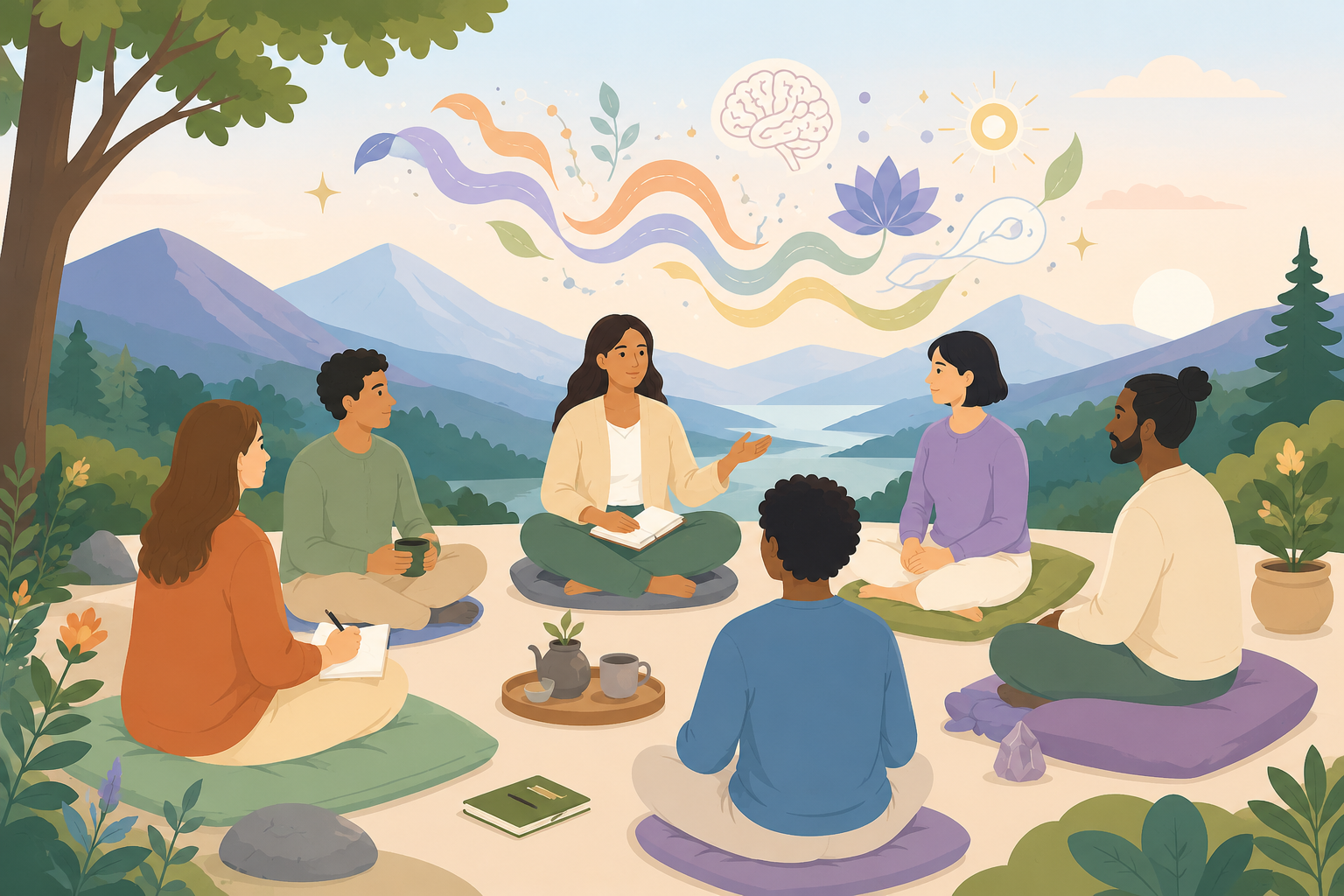
At Beckley Retreats, psychotherapists (and helping professionals) play a vital role in holding and supporting an individual throughout our program. In this article, I’ll describe how Beckley Retreats’ staff work side by side, though separately, to support an individual’s transformation.
Beckley Retreats is ostensibly an organization that facilitates psychedelic retreats, but what we are really about is supporting transformation and wellbeing. We’re a place where a special atmosphere of wellness and self-exploration is created for participants' benefit. Facilitators weave together from different disciplines - including shamanism, psychotherapy, embodiment practices, movement, meditation - to create an experience that is rich and multi-faceted.

The retreat environment encourages people to connect to simple but essential elements of wellbeing: nourishing food, time in nature, rest, connection with others, time away from their phones, self-reflection, movement, and moments of calm. There may be time around the fire in the evening, sharing songs, maybe a poem, and other lighthearted moments, too. The whole structure of the program is based on a blueprint of healthy living and habits, respect for oneself and others, and reconnection to the joy of living, vitality, and our innate wisdom.
Disclaimer: Beckley Retreats is a wellness program provider. Beckley Retreats is not a healthcare provider, does not provide medical services, and does not diagnose, treat, cure, or prevent any disease or medical condition. Information shared by Beckley Retreats is educational and informational in nature and is not a substitute for medical or mental health care.
Why Integration Matters
The intention behind the program is not simply to create a profound and deep experience during the retreat itself, but to inspire participants to bring aspects of what they experience into their everyday lives afterward. This is the gold of integration: how do I take inspiration and insight and turn it into embodied, lived experience for a better future?

Because ultimately, transformation is not an experience alone; It is a process of change over time. A mushroom does not “deliver” transformation; a human being creates it. This is why psychotherapy and integration support are so important in consolidating insights, attitude changes, and an appreciation for one’s own well-being.
Psychedelic experiences can create changes in perception and self-awareness. The person may experience themselves differently, as though the “assembly point” [1] of identity has shifted. The previously cloying strictures of the personality structure loosen, and the individual may return from retreat with a new relationship to themselves, others, life, nature, and their potential. Some might describe feeling more connected to the “essence” qualities of self: a sense of being at home in one’s own body and experiencing inner well-being. It may feel like they are swimming in the clear, pristine waters of self.

A reason why someone can feel such deep shifts is that the experience itself is total. Thoughts, feelings, emotions, bodily sensations, brain activity, and imagination - all elements of a person’s being- can become heightened. A person may feel more connected, more open, more alive, but this may also feel unfamiliar and intense. This is why it is important to enter a retreat experience with a sense of resilience and ego strength. If one is going to unsettle the ground, which is what the process looks like to change the status quo to something new, they need a strong foundation. This is why a psychedelic retreat is not for everyone and why we place such a strong emphasis on rigorous screening.
It is also important to state that psychedelic experiences can bring up unpleasant memories, feelings, and experiences. This is because the chemistry removes some of our mental filters (or defenses), allowing aspects of the unconscious to come into awareness. Elements that have been suppressed become conscious. Likewise, dreams may become quite vivid in the weeks and months after retreat, as the psyche works through the experiences and new elements come to the fore. Sometimes what arises is joyful and expansive. Sometimes it is difficult or discombobulating. In cases of the latter, the skill of an experienced therapist can turn something that feels absolutely not in one’s favor into something that absolutely is. Working with a skilled and experienced therapist can support such experiences to become elements of growth and be successfully integrated.

This is one of the reasons integration support is essential. The retreat itself is only part of the process. In many ways, the real harvest comes afterward. The participant returns home and begins building a bridge between the retreat experience and their everyday life. But when they return home to family, friends, workplaces, responsibilities, and familiar environments, they are often “meeting their past” again. And because the brain works via association, it is easy to slip back into old, familiar patterns.
The return home can often create a feeling of dissonance. The person is changing internally, but the external environment remains the same. The precious new growth that emerged during the retreat can therefore feel fragile at first, like the delicate shoots of a fledgling plant. Just as a plant needs sunlight, water, and nutrient-rich soil, the returning participant needs the right conditions to support continued growth.
The Role of Psychotherapists
This is where psychotherapists and helping professionals play such an important role. The therapist supports the navigation between the rarefied, focused atmosphere of the retreat and the return to everyday life. They help the participant stay connected to their “why”, their deeper reason for change, especially when momentum fades or challenges arise. They help the person continue to recommit and reinvest in themselves and the changes they want to create.

At Beckley, we also continue supporting participants through group integration sessions (held online) and an integration program delivered through our app, which is a self-paced process. The focus is practical and grounded. We support participants to reflect on their lives, how they want to live going forward, and what small, realistic steps they can take to realize this. By joining the group calls, participants reconnect to the flame, the essence of the retreat experience and the shared resonance that they create when together. The intention is that the calls encourage a renewed inspiration for their integration process.
Combined together - Beckley’s integration support and the participant’s individual therapist - the container supporting the person becomes stronger.
The therapist’s role in integration is myriad, including educating the participant and supporting the process. The therapist helps to cultivate a practice of self-reflection, awareness, grounding, emotional regulation, and the capacity to make more skillful choices. Over time, the individual gradually develops self-wisdom through direct experience, the practice of living a conscious life.
This process, however, does require active participation from the individual. Change does not simply happen to us. We have to engage actively in it. Patterns built from fear, pain, and protection are often deeply rooted because they were formed through survival and reinforced over many years. To move towards living from joy, connection, and wellbeing requires continual reinvestment of energy, focus, and will.

In many ways, the process is like learning to ride a bicycle. We wobble, we fall, we get back on, and we try again with a little more experience. This is where the therapist’s steady hand at our back can make all the difference. Supporting us to continue, to remain engaged with life, to keep cultivating the changes we wish to establish.
And then one day, often quietly and without fanfare, something changes. Not through one great, light-in-the-sky moment, but through many small acts of intention and practice. We realise we are no longer relating to ourselves in the same way; we have changed. We begin living from a deeper wellspring of creativity, connection and wellbeing that is innate.
This is why transformation has been described as the “hard work miracle”[2]. And why the role of both a psychedelic retreat and psychotherapy is ultimately the same: to support a person to connect to their true nature and to increasingly live from this place.
Sources
-
Castaneda, C. (1984). The fire from within. Simon & Schuster.
-
Johnson, S. M. (1985). Characterological transformation: The hard work miracle. W. W. Norton & Company.
Before you apply
Beckley runs legal, guided psilocybin retreats in Jamaica and psilocybin retreats in the Netherlands: four weeks of preparation, two guided sessions on retreat, six weeks of integration, online and at your own pace, one to two hours a week. Plain answers to the questions people ask first:
What a psilocybin retreat costs · What happens, day by day · Jamaica or the Netherlands · Who should not attend · Apply