-2-1.png)

The story of psilocybin doesn’t belong to a single person or have a linear trajectory. It stretches from Mesoamerican ceremony to Swiss laboratories, from Harvard classrooms to congressional hearings, carried forward by healers, scientists, advocates, enthusiasts, and writers who each played a role in shaping where we are today.
While this won’t cover every person who has contributed to the rich history of psilocybin mushrooms' relationship with humans, it will scratch the surface of some of the better-known figures and the moments that defined that history.
Indigenous Traditions and the Origins of Psilocybin Mushrooms
Psilocybin mushrooms have been used ceremonially in Mesoamerica for centuries, and are woven into the spiritual and healing practices of numerous Indigenous communities across what is now Mexico and Central America. Among these, the Mazatec healer Maria Sabina became a pivotal figure in bridging the Indigenous psilocybin ceremony and the wider world, leading the ritual that introduced Western ethnomycologist R. Gordon Wasson to the transformative potential of sacred mushrooms in 1955.
Maria Sabina (c.1894-1985)
A Maztec healer, called a chjota chijne in her own language, Sabina was revered within her community for her veladas and her relationship with the sacred mushrooms she called the niños santos, or "little saints." Her ceremonies wove together Indigenous healing practice and syncretic Catholic elements, and she was known as a master of the form.
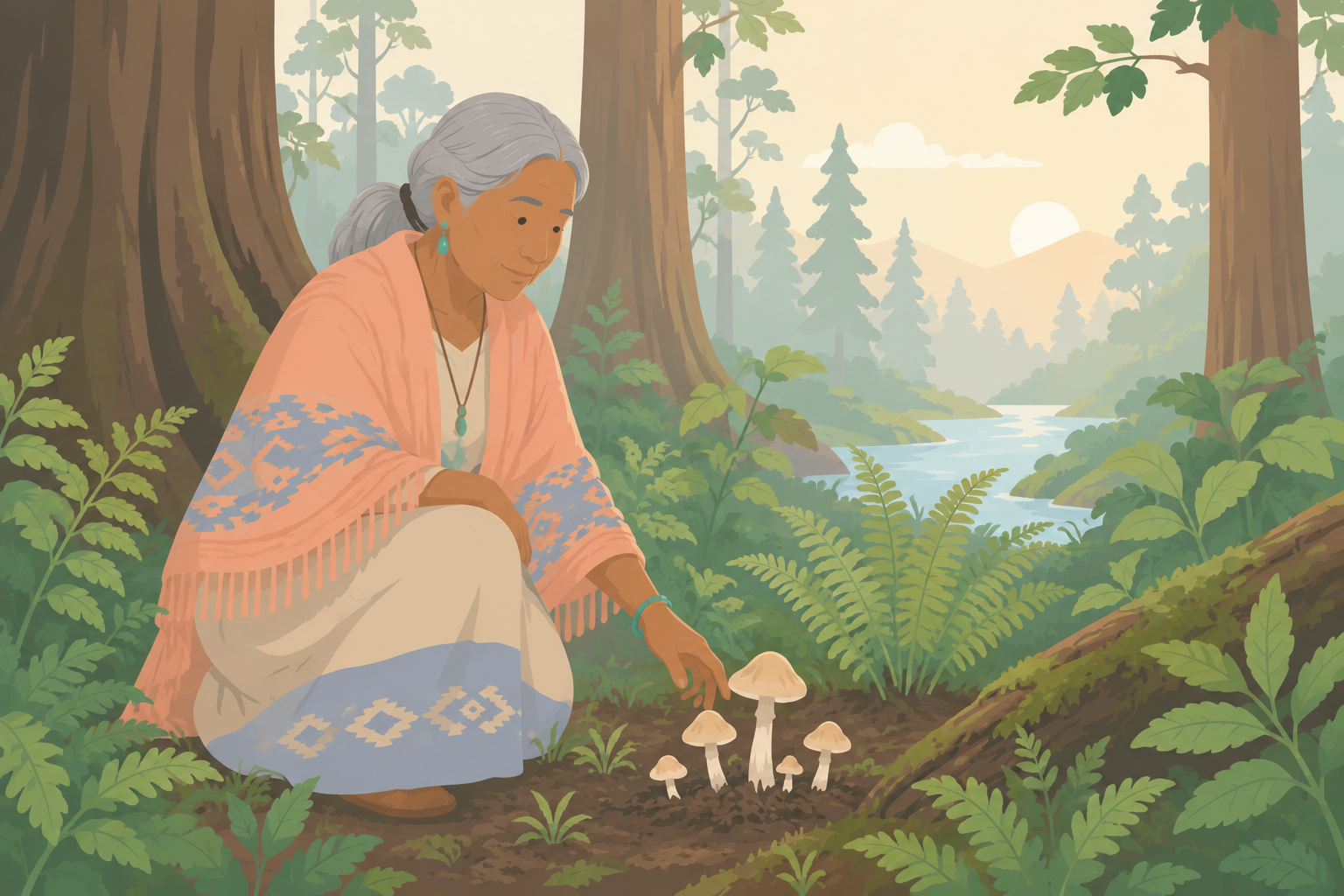
In June 1955, an American named R. Gordon Wasson arrived in Huautla de Jiménez, where a local town official pressured Sabina, initially uncertain of him, into allowing Wasson and his photographer to witness and participate in a velada. Wasson published his account in Life magazine in 1957, in an article titled “Seeking the Magic Mushroom,” which marked the introduction of psilocybin to the modern Western world. Six days later, on May 19, 1957, his wife Valentina Wasson published her own account of the experience in This Week.
The Life article's coverage led to a flood of outsiders seeking out Huautla de Jiménez for psilocybin experiences. The unwanted attention altered the social dynamics of the Mazatec community, and came at huge personal cost to Maria Sabina. She was ostracized from her community, her son was murdered, and angry community members burned down her home. Beyond these impacts, she was briefly jailed by the authorities and spent her final years in isolation and poverty, ultimately lamenting that the foreigners’ pursuit of seeking a “high” destroyed the spiritual power of the mushrooms.
Sabina’s story is important to acknowledge. The Western world has access to this wisdom because of an Indigenous woman who sacrificed her community, home, and son when she allowed an outsider to partake in her ritual.
Researchers Who Introduced Psilocybin to Western Science
There were many steps between the days of the veladas and today’s global experience of and relationship with psilocybin. And, like most good stories, it doesn’t have a linear path.
R Gordon Wasson
Wasson was originally Vice President of Public Relations at J.P. Morgan, and hardly the kind of person you'd expect to bring psilocybin to the West. A deeply curious banker-turned-ethnomycologist, Wasson helped shape the history of psilocybin through his 1957 Life magazine article, which introduced Mazatec mushroom ceremonies of the Sierra Mazateca to a mainstream audience.
There was a follow-up expedition that was quietly funded by the CIA’s MKUltra mind-control program. Wasson was accompanied by French mycologist Roger Heim, who identified several of the mushrooms as Psilocybe species, cultivated them in his laboratory in France, and sent a sample of dried Psilocybe mexicana to Sandoz Laboratories in Basel. There, those samples would land in the hands of the chemist who would give psilocybin its scientific identity.
Albert Hofmann
Albert Hofmann is most famously known for synthesizing LSD in 1938, and later in 1943, taking the first LSD trips (first accidentally in his lab), concluding in the annual celebration of Bicycle Day. The lab where Hofmann performed his psychedelic research was Sandoz Laboratories, the very same one that Wasson sent the psilocybin samples to.
Working from samples of Psilocybe mexicana, Hofmann and his colleagues at Sandoz isolated psilocybin and psilocin, the primary psychoactive compounds in magic mushrooms. It elucidated their chemical structures in 1958, reporting the synthesis of psilocybin that same year in Experientia. A comprehensive multi-author study was published in 1959 in Helvetica Chimica Acta, fully documenting the isolation and characterization of both compounds. For the first time, the active compounds had scientific names and chemical structures, and could be reliably reproduced in a laboratory setting. Sandoz distributed the compound to researchers and psychiatric clinics under the brand name Indocybin, sparking a wave of clinical investigation throughout the early 1960s.
Still, it was a minor side act to LSD, which Sandoz had released over a decade earlier as Delysid and which dominated that era’s research. Only in recent decades has psilocybin overtaken it.
Timothy Leary, Richard Alpert, and the Harvard Psilocybin Project
The conversation about psychedelic research would be incomplete without acknowledging Timothy Leary and Richard Alpert's contributions. In 1960, two young psychologists at Harvard, Timothy Leary and Richard Alpert (later known as Ram Dass), began studying and exploring the effects of psilocybin on human consciousness and documented their experiences in real time. This was prompted by Leary, who had read Wasson’s Life Magazine article and wanted to sample it himself. At this time, psilocybin and LSD were not illegal in the United States.
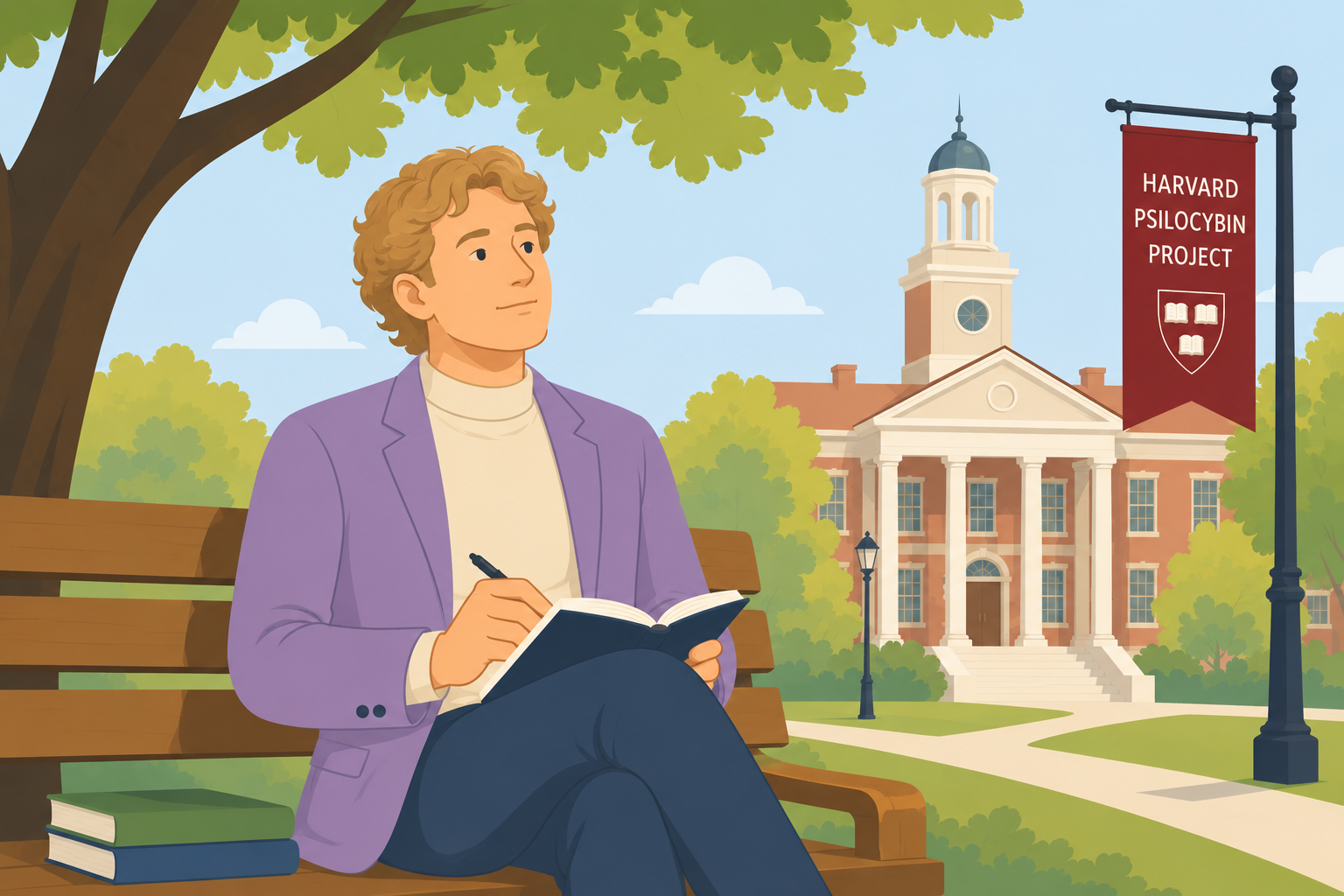
By 1962, faculty and administrators were raising concerns about subject safety and testing rigor, including poorly controlled conditions, non-random subject selection, and researchers being under the influence of psilocybin during investigations. Editorials in the Harvard Crimson went further, accusing Leary and Alpert of not merely studying psychotropic drugs but actively promoting their recreational use.
The pair agreed to policies meant to protect subjects, including a prohibition on undergraduate participation, which was a rule Alpert violated when he administered psilocybin to an undergraduate student off-campus in the spring of 1963. He was dismissed; Leary was also fired, and the Harvard Psilocybin Project came to an abrupt end.
Leary went on to become the one to popularize the phrase “Tune in, Turn on, Drop Out”, a term that is iconic in psychedelic history. Leary played an extremely important role in the history of psychedelics. His antics arguably brought research on the substance to a crawl in comparison to its height, but in terms of generating wider public awareness and democratizing their use outside of research or clinical contexts, his influence was pivotal.
Terence and Dennis McKenna
Terence (1946-2000) and Dennis McKenna (b. 1950) brought psilocybin cultivation out of the wild and into domestication. During a 1971 expedition to the Colombian Amazon in search of a different psychoactive plant, the brothers found Psilocybe cubensis growing on cattle dung and carried spore prints back with them. In 1976, writing under the pseudonyms O.T. Oss and O.N. Oeric, they published Psilocybin: Magic Mushroom Grower’s Guide, the first reliable manual for growing mushrooms at home, which popularized the hobby and made psilocybin an open-source. Terence went on to become psychedelics’ most prolific public voice through decades of talks and books, while Dennis pursued a research path in ethnopharmacology, co-founding the Heffter Research Institute.
The Scientists Leading the Modern Psychedelic Renaissance
With Timothy Leary, research was closed at Harvard in 1963. It didn’t truly resume until the late 1900s and early 2000s, when a new generation of scientists began rebuilding the case with the rigor the earlier era had lacked. There are three influential figures who have led the resurgence of psychedelic research.
Roland Griffiths (1946-2023)
Griffiths’ 2006 landmark study grew out of a meeting at Esalen between Griffiths and Robert Jesse, a computer engineer who was pushing for research into psychedelics’ spiritual potential, including their capacity to contribute to the betterment of well people, rather than a strictly clinical one. That conversation helped spark the study, which demonstrated that a single high dose of psilocybin in hallucinogen-naïve adults produced experiences of substantial personal and spiritual significance, with sustained positive changes in attitudes and behaviors. His work generated $17 million in gifts, leading to the creation of the Johns Hopkins Center for Psychedelic and Consciousness Research in 2019, where he served as founding director. He died in October of 2023 at age 77.
Robin Carhart-Harris
Carhart-Harris is best known for building the clinical evidence base of psilocybin research and conducting research on how psychedelics influence brain function. In 2016, his team at Imperial College London published findings in The Lancet Psychiatry from the world's first modern research trial investigating psilocybin for treatment-resistant depression, demonstrating that the approach was not only feasible and safe, but produced meaningful reductions in depressive symptoms.
He founded the Centre for Psychedelic Research at Imperial College in 2019, the first of its kind in the world, and is now the Ralph Metzner Distinguished Professor of Neurology and Psychiatry at the University of California, San Francisco.
Rick Doblin
Doblin’s contributions have come in the form of policy and advocacy infrastructure that have made clinical psychedelic research legally possible. He founded the Multidisciplinary Association for Psychedelic Studies (MAPS) in 1986, which has become a pivotal organization in the psychedelic renaissance. Doblin had a goal of developing legal contexts for the beneficial uses of psychedelics, including as prescription medicines, and in the four decades since its inception, MAPS has been responsible for navigating psychedelic research through the regulatory system.
Writers and Public Figures Who Changed Public Perception
While scientific credibility matters in shifting public opinion, books, podcasts, television, movies, and conversations are what move the mainstream towards a psychedelic future. A 2025 analysis of media coverage and psychedelics from 2000 to 2025 found an average positive sentiment score of 78.5 out of 100 across more than 2,000 articles, with only 1.3% of coverage carrying negative sentiment.
Michael Pollan
This may be in part because of Michael Pollan, the famous author who, in 2018, wrote How to Change Your Mind in order to bring psychedelic science to those who may have never considered it. Pollan, who is largely known for his journalistic take on food and agriculture, combined personal experience with careful reporting on the clinical research, neuroscience, and cultural history of psychedelics. It became a bestseller and was adapted into a Netflix documentary series.
While Pollan didn’t make a new psychedelic discovery, he translated the science for a general audience in a way that made it accessible without oversimplifying it. His book also built bridges beyond the psychedelic community, engaging readers who’d otherwise have never encountered the research. Researchers have documented this as a "Pollan effect": one study found a measurable rise in health-focused, socially engaged discussion of psilocybin in online communities following the book's release, suggesting his writing helped shift psychedelics from a niche, insular conversation into a broader public one.
Documentaries and Celebrity Voices
There have been many instances of psilocybin appearing in current pop culture outside of books as well. Netflix created a documentary, Have a Good Trip: Adventures in Psychedelics, in 2020 that brought celebrity accounts from Sting, Carrie Fisher, Ben Stiller, Nick Kroll, and Natasha Lyonne into the conversation.

Public figures like Mike Tyson, Megan Fox, Kristen Bell, Miley Cyrus, and Will Smith have all spoken openly about their experiences with psychedelics in the context of personal growth and mental health. This normalization helps continue the conversation and standardize psychedelic research.
In April 2026, President Trump signed an Executive Order aimed at expanding access to psychedelic-assisted therapies for patients with serious mental illnesses, with a particular focus on veterans. This could lead to the future rescheduling of certain drugs and could lead to more research, clinical trials, and accessibility for those who want to utilize psychedelics for their potentially life-changing properties.
Why These Figures Still Matter Today
Psychedelic therapy is increasingly approaching mainstream acceptance. Clinical research continues at Johns Hopkins, UCSF, and a growing number of institutions. While we look to the future of psychedelics, it’s always important to remember the people who have moved the conversation forward. Multiple jurisdictions have moved toward legalization or decriminalization of psilocybin for therapeutic use, and the structured retreat model has been adopted in places like Jamaica and the Netherlands.
But the same ethical questions that should have been asked in 1957 remain unresolved. Who benefits from the commercial development of a compound whose origins lie in Indigenous ceremony? What protections exist for communities like the Mazatec? And how does the clinical framing relate to the ceremonial context that developed the knowledge in the first place?
The story begins with María Sabina, and she must be remembered to tell the story honestly. Everything was built on that foundation, and because of it, we have scientists who constructed the evidence base, advocates who fought a regulatory system determined to bury it, and writers and speakers who carried the conversation out of academic journals and into the places where most people form their views.
Frequently Asked Questions
Sources
- Aday, Jacob S., et al. "Psychedelic Commercialization: A Wide-Spanning Overview of the Emerging Psychedelic Industry." Psychedelic Medicine, vol. 1, no. 3, 2023, pp. 150–165. PMC, pmc.ncbi.nlm.nih.gov/articles/PMC11661494/.
- American Chemical Society. "Psilocybin." Molecule of the Week Archive, acs.org/molecule-of-the-week/archive/p/psilocybin.html.
- Beckley Retreats. "The Evolution and History of Psilocybin Mushrooms." Beckley Retreats Blog, 12 Mar. 2024, beckleyretreats.com/blog/the-history-of-psilocybin-usage.
- Caldwell, Brendan. "Examining the Discursive Role of María Sabina in Modern Psychedelic Therapy." Chacruna, 19 Mar. 2025, chacruna.net/examining-the-discursive-role-of-maria-sabina-in-modern-psychedelic-therapy/.
- Carhart-Harris, Robin L., et al. "Psilocybin with Psychological Support for Treatment-Resistant Depression: An Open-Label Feasibility Study." The Lancet Psychiatry, vol. 3, no. 7, 2016, pp. 619–627. PubMed, doi.org/10.1016/S2215-0366(16)30065-7.
- Doblin, Rick. "Rick Doblin." Multidisciplinary Association for Psychedelic Studies, maps.org/people/rick-doblin/.
- Edelstein, Elisa. "What Is Bicycle Day? Albert Hofmann's Infamously Wild Ride." Beckley Retreats Blog, 23 Apr. 2026, beckleyretreats.com/blog/what-is-bicycle-day-albert-hofmanns-infamously-wild-ride.
- González Romero, Osiris. "Ritual and Religious Uses of Psilocybe Mushrooms in Mesoamerica." Center for the Study of World Religions, Harvard Divinity School, 9 Oct. 2024, cswr.hds.harvard.edu/news/2024/10/ritual-and-religious-uses-psilocybe-mushrooms-mesoamerica.
- Griffiths, R. R., et al. "Psilocybin Can Occasion Mystical-Type Experiences Having Substantial and Sustained Personal Meaning and Spiritual Significance." Psychopharmacology, vol. 187, no. 3, 2006, pp. 268–283. Johns Hopkins University, doi.org/10.1007/s00213-006-0457-5.
- Harvey, Ifetayo, et al. "How Researchers and Advocates of Color Are Forging Their Own Paths in Psychedelic-Assisted Therapy." WHYY on PBS, reprinted by Multidisciplinary Association for Psychedelic Studies, 11 Jan. 2020, maps.org/news/media/whyy-on-pbs-how-researchers-and-advocates-of-color-are-forging-their-own-paths-in-psychedelic-assisted-therapy/.
- Heffter Research Institute. "Dennis J. McKenna, PhD." heffter.org/dennis-j-mckenna-phd/.
- Hofmann, A., et al. "Konstitutionsaufklärung und Synthese von Psilocybin." Experientia, vol. 14, no. 11, 1958, pp. 397–399, doi.org/10.1007/BF02160424.
- Hofmann, A., et al. "Psilocybin und Psilocin, Zwei Psychotrope Wirkstoffe aus Mexikanischen Rauschpilzen." Helvetica Chimica Acta, vol. 42, no. 5, 1959, pp. 1557–1572, doi.org/10.1002/hlca.19590420518.
- Hofmann, A., et al. "Psilocybin, a Psychotropic Substance from the Mexican Mushroom Psilocybe mexicana Heim." Experientia, vol. 14, no. 3, 1958, pp. 107–109. PubMed, doi.org/10.1007/BF02159243.
- Johns Hopkins Medicine. "Roland Griffiths, Pioneering Psychedelic Researcher, Dies." Johns Hopkins Medicine Newsroom, 18 Oct. 2023, hopkinsmedicine.org/news/newsroom/news-releases/2023/10/roland-griffiths-pioneering-psychedelic-researcher-dies.
- Leary, Timothy. "Timothy Leary." Department of Psychology, Harvard University, psychology.fas.harvard.edu/people/timothy-leary.
- MAPS Celebrates 40 Years at a Defining Moment for Psychedelics. Multidisciplinary Association for Psychedelic Studies, 23 Apr. 2026, maps.org/2026/04/23/maps-celebrates-40-years-at-a-defining-moment-for-psychedelics/.
- McKenna, Dennis. "The Experiment at La Chorrera: A 50-Year Retrospective." McKenna Academy of Natural Philosophy, mckenna.academy/the-experiment-at-la-chorrera-a-50-year-retrospective/.
- McKenna, Terence, and Dennis McKenna (as O.T. Oss and O.N. Oeric). Psilocybin: Magic Mushroom Grower's Guide. Lux Natura, 1976. Psilosophy, psilosophy.info/resources/Psilocybin.magic.mushroom.growers.guide.pdf.
- Neuroscape, University of California San Francisco. "Robin Carhart-Harris." Neuroscape, neuroscape.ucsf.edu/profile/robin-carhart-harris/.
- Pendse, Sachin R., et al. "Quantifying the Pollan Effect: Investigating the Impact of Emerging Psychiatric Interventions on Online Mental Health Discourse." Proceedings of the 2024 CHI Conference on Human Factors in Computing Systems, Association for Computing Machinery, 11 May 2024, doi.org/10.1145/3613904.3642477.
- Pollan, Michael. How to Change Your Mind: What the New Science of Psychedelics Teaches Us About Consciousness, Dying, Addiction, Depression, and Transcendence. Penguin Press, 2018.
- Fantastic Fungi. Directed by Louie Schwartzberg, Moving Art, 2019. Netflix, netflix.com/title/80229847.
- Trump, Donald J. "Fact Sheet: President Donald J. Trump Is Accelerating Medical Treatments for Serious Mental Illness." The White House, 18 Apr. 2026, whitehouse.gov/fact-sheets/2026/04/fact-sheet-president-donald-j-trump-is-accelerating-medical-treatments-for-serious-mental-illness/.
- Wasson, R. Gordon. "Seeking the Magic Mushroom." LIFE, 13 May 1957, pp. 100–102. Republished by Original LIFE Magazines, originallifemagazines.com/seeking-the-magic-mushroom/.
Before you apply
Beckley runs legal, guided psilocybin retreats in Jamaica and psilocybin retreats in the Netherlands: four weeks of preparation, two guided sessions on retreat, six weeks of integration, online and at your own pace, one to two hours a week. Plain answers to the questions people ask first:
What a psilocybin retreat costs · What happens, day by day · Jamaica or the Netherlands · Who should not attend · Apply