-2-1.png)

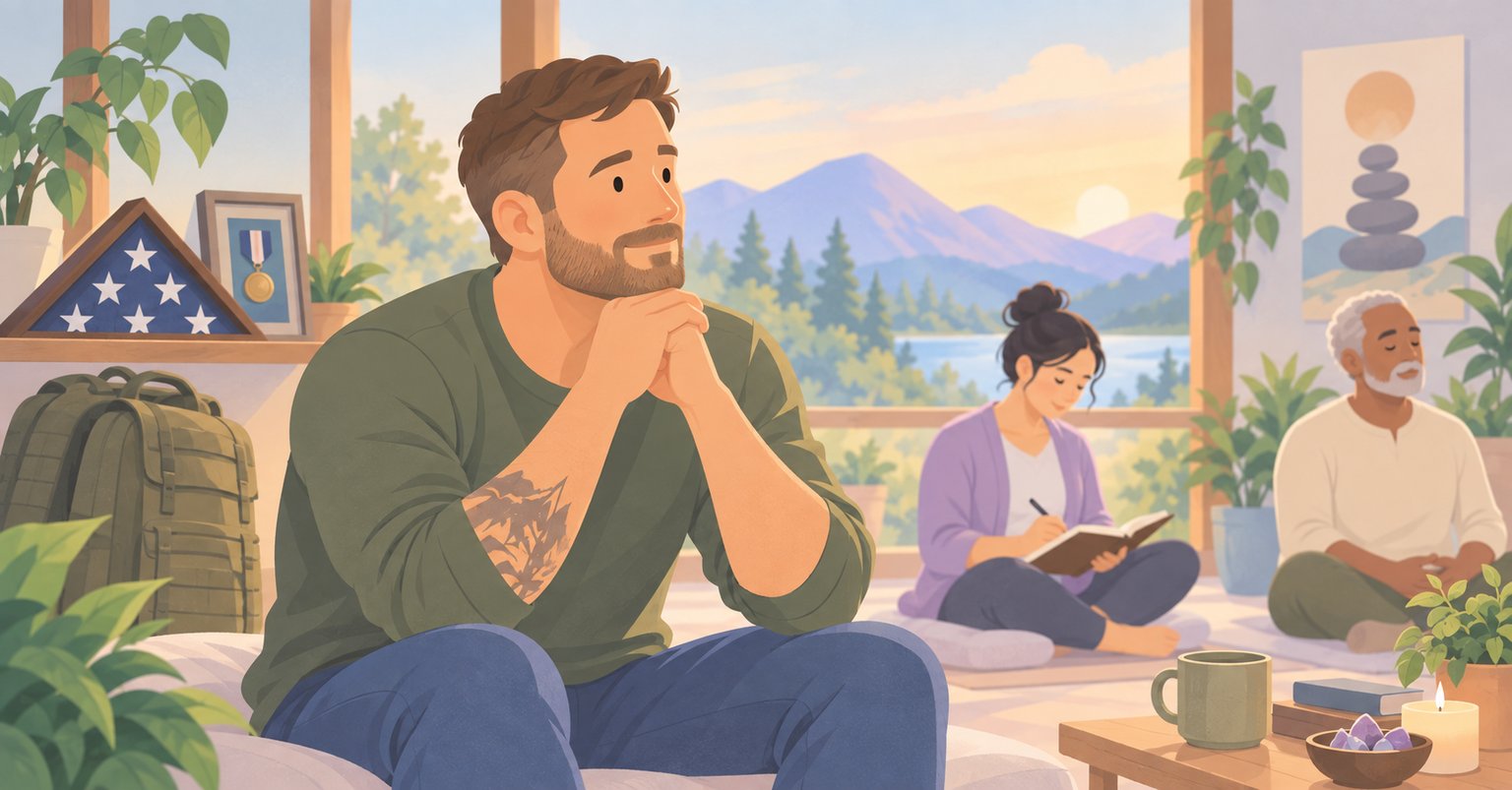
Veterans are in peril.
That’s not alarmism or embellishment. Military servicemembers face mental health struggles in staggering amounts. According to government data, suicide is the second-leading cause of death for veterans under 45. Mental health ailments like PTSD terrorize “substantial and growing proportions” of U.S. veterans.

What’s happening here?
The U.S. Government Accountability Office cites logistical hurdles. On Capitol Hill, politicians push funding toward private care, putting the impetus on the sufferer. An Air Force veteran with PTSD, who was interviewed for this article on the condition that they remain anonymous, puts it plainly:
“The system is nearly impossible to navigate for veterans who need higher levels of care.”
Beyond the bureaucracy, veterans and researchers alike are exploring other avenues. If emerging research continues to show promise - and so far, it is promising - psilocybin retreats for veterans, which provide access to these drugs outside of clinical avenues, may serve as a haven for suffering troops who can’t find relief elsewhere.
What Research Says About Psychedelics & Trauma
Trauma is complicated. People with PTSD contend with persistent physical and emotional symptoms linked to the triggering event. Veterans needn’t see combat to be afflicted, either.
Navigating and mending trauma is equally multifaceted and not always responsive to standard interventions.

That’s where psychedelics may have a role to play.
- Studies on psilocybin administration in PTSD sufferers remark that the drug’s psychoactive properties may help disrupt the “rigid and restrictive” internal conditions that maintain PTSD.
- Ketamine, originally used as a battlefield triage drug, has been shown in clinical trials to “significantly and rapidly reduce” PTSD symptoms as well when administered via IV.
Psychedelic usage is not settled science. Research into their clinical potential was, for decades, stymied by cultural attitudes and political intervention. As attitudes shift and restrictions loosen, scientists are beginning to put veterans under the microscope.
The only consensus so far? There may be untapped potential - but much, much more research is needed. In a laboratory setting, caution calls the shots.
Psilocybin Retreats for Veterans: What Must Be Included
Psilocybin retreats are privately owned enclaves, not government-run clinics. Reputable retreats employ qualified staff to design, implement, and oversee guided psychedelic usage. Some enter retreats for leisure. Others turn to psychedelic stewardship for mental health.

If you’re a veteran considering a psilocybin retreat, there are a few things you should know beforehand.
- Psilocybin often requires pre-screening. It can produce intense psychological experiences and may be contraindicated for patients with certain pre-existing conditions. Responsible retreats put all candidates through extensive medical and background screens.
- Facilitators must be needs-matched. Think of them more like lifeguards than drill sergeants; facilitators keep psilocybin users “on the path” during the session. Quality retreats employ trauma-informed facilitators with relevant experience.
- Psilocybin isn’t triage. Retreats can last several days to a week, and require ongoing psychological support afterward in order to sustain benefits.
Psilocybin Retreats for Veterans: Risks & Considerations
Psilocybin is not appropriate for everyone. Research indicates certain psychiatric conditions, such as schizophrenia or bipolar disorder, may complicate things for some prospective users.

The drug may also bring you closer than expected to the root of your trauma in the way an open flame provides warmth until you get too close. “Bad trips” or challenging experiences happen, and some data indicate around 10% of users report putting themselves or others at risk of harm.
You should also be wary of exploitative or emotionally charged marketing. Any retreat which promises a “cure” to PTSD is more concerned with what’s going on in your wallet than your head. Reputable, patient-focused retreats will clearly lay out the risks and benefits to help you make an informed decision.
Community and Integration Make the Difference
Veterans returning home often feel like they’re stepping onto foreign soil all over again, especially if they’ve seen combat. What may seem like immersion into normal life, with all the adoration and lip service, can be cold and isolating for troubled servicemembers.

Logistical hurdles and excessive red tape barring troubled veterans from quality care only worsens this predicament. In contrast, psilocybin retreats are deeply communal: Guests are afforded privacy, but much of the program and subsequent integration relies on group-based activity and bonding.
Isolation is a pit. Seeing your struggles acknowledged and reflected in your peers is a lifeline. Don’t be afraid to reach out and take hold.
Frequently Asked Questions
Sources
- Pietrzak RH, Fischer IC, Na PJ, Harpaz-Rotem I, Petrakis IL, Krystal JH. National Trends in Posttraumatic Stress Disorder Among US Military Veterans: Results From the 2025-2026 National Health and Resilience in Veterans Study. J Clin Psychiatry. 2026 May 25;87(3):26m16378. doi: 10.4088/JCP.26m16378. PMID: 42207989.
- Ellis S, Bostian C, Donnelly A, Feng W, Eisen K, Lean M, Conlan E, Ostacher M, Aaronson S, Suppes T. Long-term outcomes of single-dose psilocybin for U.S. military Veterans with severe treatment-resistant depression - 12-month data from an open-label pilot study. J Affect Disord. 2025 Nov 15;389:119655. doi: 10.1016/j.jad.2025.119655. Epub 2025 Jun 9. PMID: 40499827.
- Krediet E, Bostoen T, Breeksema J, van Schagen A, Passie T, Vermetten E. Reviewing the Potential of Psychedelics for the Treatment of PTSD. Int J Neuropsychopharmacol. 2020 Jun 24;23(6):385-400. doi: 10.1093/ijnp/pyaa018. PMID: 32170326; PMCID: PMC7311646.
- Modlin NL, Williamson V, Maggio C, Stubley J, Kirlic N, Cleare A, Rucker J. Clinical conceptualisation of PTSD in psilocybin treatment: disrupting a pre-determined and over-determined maladaptive interpretive framework. Ther Adv Psychopharmacol. 2025 Jun 8;15:20451253251342319. doi: 10.1177/20451253251342319. PMID: 40492108; PMCID: PMC12146596.
- Feder A, Parides MK, Murrough JW, Perez AM, Morgan JE, Saxena S, Kirkwood K, Aan Het Rot M, Lapidus KA, Wan LB, Iosifescu D, Charney DS. Efficacy of intravenous ketamine for treatment of chronic posttraumatic stress disorder: a randomized clinical trial. JAMA Psychiatry. 2014 Jun;71(6):681-8. doi: 10.1001/jamapsychiatry.2014.62. PMID: 24740528.
- Morton E, Sakai K, Ashtari A, Pleet M, Michalak EE, Woolley J. Risks and benefits of psilocybin use in people with bipolar disorder: An international web-based survey on experiences of 'magic mushroom' consumption. J Psychopharmacol. 2023 Jan;37(1):49-60. doi: 10.1177/02698811221131997. Epub 2022 Dec 14. PMID: 36515370; PMCID: PMC9834328.
- Carbonaro, T. M., Bradstreet, M. P., Barrett, F. S., MacLean, K. A., Jesse, R., Johnson, M. W., & Griffiths, R. R. (2016). Survey study of challenging experiences after ingesting psilocybin mushrooms: Acute and enduring positive and negative consequences. Journal of Psychopharmacology, 30(12), 1268–1278.
Sources
- government data (mentalhealth.va.gov). https://www.mentalhealth.va.gov/docs/data-sheets/2025/2025_National_Veteran_Suicide_Preven
- terrorize (pubmed.ncbi.nlm.nih.gov). https://pubmed.ncbi.nlm.nih.gov/42207989/
- cites (gao.gov). https://www.gao.gov/products/gao-24-107752
- so far (pubmed.ncbi.nlm.nih.gov). https://pubmed.ncbi.nlm.nih.gov/40499827/
- physical and emotional symptoms (ptsd.va.gov). https://www.ptsd.va.gov/professional/assessment/adult-sr/ptsd-checklist.asp
- needn’t see combat (ptsd.va.gov). https://www.ptsd.va.gov/understand/common/common_veterans.asp
- not always responsive (pmc.ncbi.nlm.nih.gov). https://pmc.ncbi.nlm.nih.gov/articles/PMC7311646/
- remark (pmc.ncbi.nlm.nih.gov). https://pmc.ncbi.nlm.nih.gov/articles/PMC12146596/
- clinical trials (pubmed.ncbi.nlm.nih.gov). https://pubmed.ncbi.nlm.nih.gov/24740528/
- indicates (pmc.ncbi.nlm.nih.gov). https://pmc.ncbi.nlm.nih.gov/articles/PMC9834328/
Before you apply
Beckley runs legal, guided psilocybin retreats in Jamaica and psilocybin retreats in the Netherlands: four weeks of preparation, two guided sessions on retreat, six weeks of integration, online and at your own pace, one to two hours a week. Plain answers to the questions people ask first:
What a psilocybin retreat costs · What happens, day by day · Jamaica or the Netherlands · Who should not attend · Apply