-2-1.png)

The White Lotus effect is real.
According to Business Insider, HBO’s flagship series of debauchery and drama at high-end retreats has tangible impacts on real-world tourism. Meanwhile, interest in psychedelic therapies and retreats continues to rise as people seek holistic pathways to optimizing their health.
Luxury psilocybin retreats prioritize the guest experience, but not at the expense of the quality of care. With wellness tourism on the rise, it’s more important than ever to choose a destination that isn’t style over substance.
Why Luxury Psychedelic Retreats Are Growing
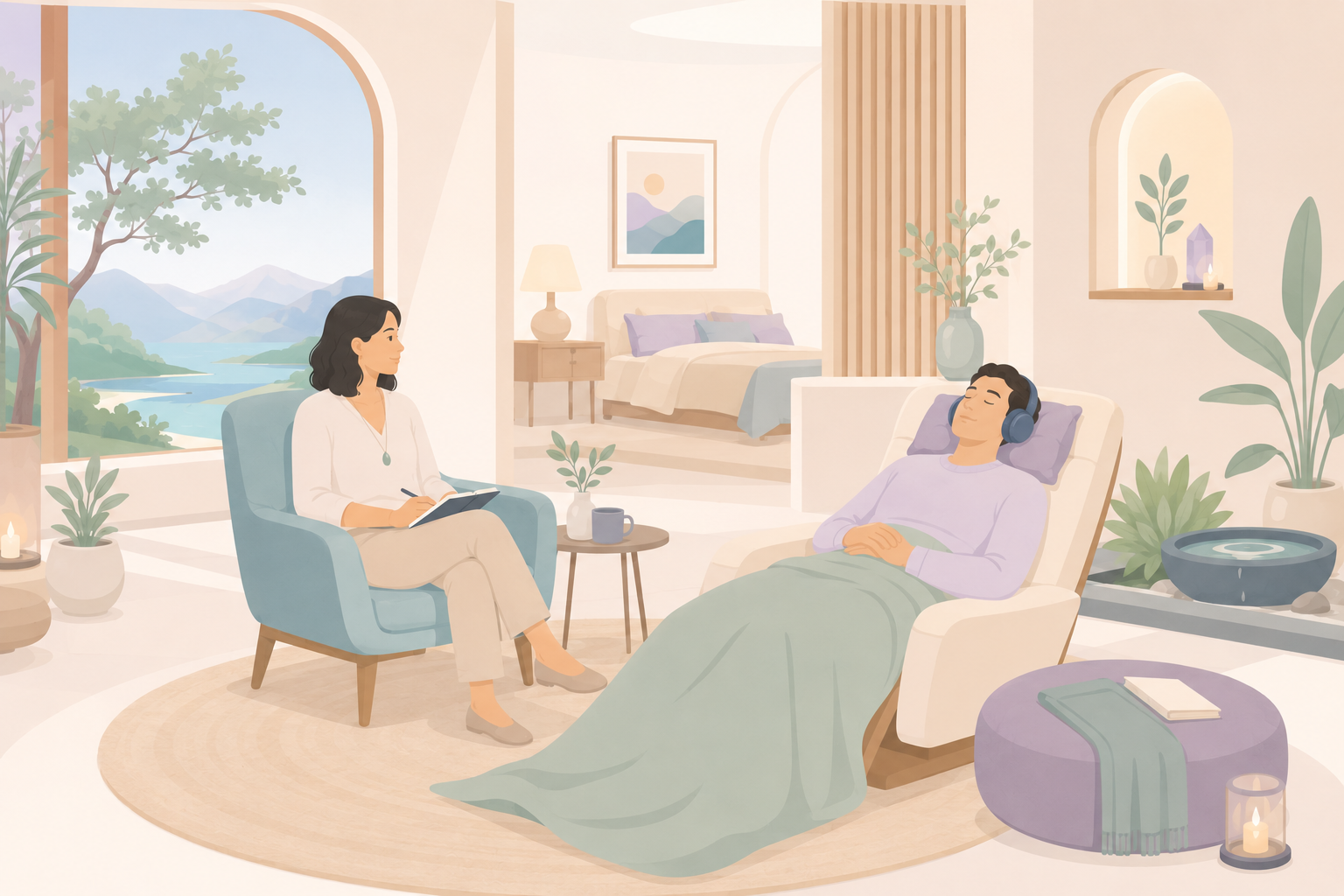
Luxury psychedelic retreats offer access to drugs like psilocybin, ketamine, or ayahuasca in controlled, supervised settings, similar to clinical treatments. However, retreats place extra emphasis on curating a serene guest experience.

Psychedelic retreats aren’t walk-in clinics that require a plane ticket. They’re often multi-day to week-long immersive experiences, providing comprehensive and holistic care before, during, and after consuming any drug.
It’s exactly why psychedelic retreats are popular destinations for business execs suffering from burnout and those seeking a new perspective alike:
What Separates a High-End Retreat From a Marketing-Driven One
Psychedelic care comes with its own unique parameters. Clinical standards matter when dealing with mind-altering substances. Luxury psychedelic retreats, staffed appropriately and with a comprehensive program in place, meet these demands.

Take insights from clinical reviews of safe psychedelic research. These benchmarks are also commonly found in reputable psychedelic retreats. Broadly speaking, safe administration of psychedelics requires:
- Thorough pre-screening procedures and a willingness to exclude participants if needed
- Qualified and experienced facilitators and medical staff
- Establishment of trust and rapport between staff and guests
- Careful pre-session preparation
- Curation of a safe physical environment and healthy mental set
- Interpersonal support during and after the session
For some luxury psychedelic retreats, these are foundational requirements. Marketing-driven retreats often skip steps and rely on hype rather than science and expertise.
What “Luxury” Actually Means for Psychedelic Retreats
Psychedelic retreats are still tourist destinations. Many programs are held in scenic areas like Jamaica, where cultural sensibilities around psychedelics are more permissive. High-quality retreats provide a curated, relaxing experience, but the real luxury comes from the quality of care guests receive.
Environment
Retreats should be curated to quell anxiety, not elevate it. Accommodation should include private rooms intentionally designed to maximize the experience - soft music, soft surfaces, and other sensory considerations matter.
Program
Retreat programs are generally structured in phases. The preparation period consists of medical intakes, intention setting, and familiarization with the overarching principles behind the retreat. This helps guests acclimate to the environment and enter the session knowing what to expect.
Staff
Qualified staff are essential for any retreat - in quantity and quality alike. A good retreat should have a 5:1 ratio of guests to facilitators. If the program is understaffed, guests may not receive the personalized attention they require to thrive.
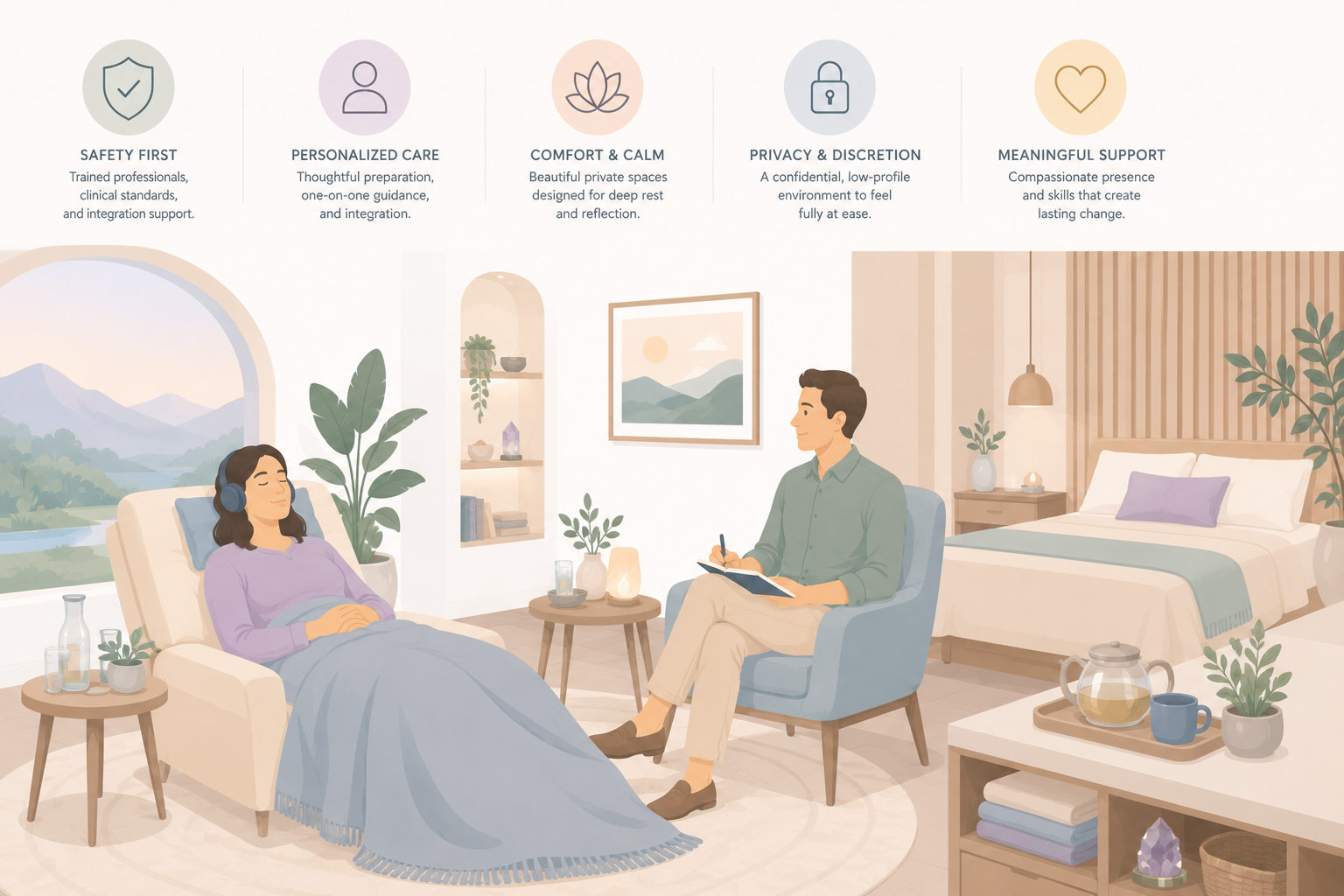
Retreats should also have medically trained personnel on-site and procedures in place in the event of medical emergencies. “Serious adverse events” are generally rare when psychedelics are administered properly, but retreats must consider all possible risks, however unlikely.
Support
Post-session support is imperative for psychedelic users seeking to maximize the benefits derived from a particular experience. In a nutshell, drugs like psilocybin “till the soil” in your mind, opening new neural connections and, at times, bringing deep-seated traumas to the forefront.
It’s hard to work through these things alone. Luxury retreat facilitators help steer and shepherd guests through the process of integration - making sense of the ineffable feelings and turning them into productive, actionable insights.
Psychedelic Retreat Red Flags
Psychedelic retreats can vary significantly in quality because they aren’t subject to governmental oversight, even in places where psychedelics are widely legal. As such, more of the burden falls on the consumer. For the prospective psychedelic voyager, that means being able to identify red flags.
- Overpromising: Psychedelics are not guaranteed to cure any disease or remedy any ailment. Any program that frames their practice as a panacea, magic pill, or miracle cure is lying.
- Vagueness: Retreat programs should be clear and transparent. If, at any point, you feel like you’re being run around with opaque “details” about itinerary, pricing, staff qualifications, or anything else, give them a wide berth.
- Brevity: Taking psychedelics is generally a multi-day affair. Retreat programs should provide ample on-ramp time and space to decompress afterward. You shouldn’t feel dragged in or shuffled out at any point.
How To Evaluate if a Luxury Psychedelic Retreat Is Worth the Cost
Luxury psychedelic retreats are expensive, and many market directly to high earners. But a large price tag isn’t the same as prestige.

Before you decide to drop thousands of dollars - some programs run well into the tens of thousands - on a psychedelic retreat, make sure it has all of the following:
- Sufficient staff with appropriate qualifications. Ideally, staff expertise should vary somewhat.
- Set-in-stone emergency procedures. Guests are not responsible for managing issues or solving crises. Ask the resort how they deal with sessions gone awry (and don’t believe them if they say it never happens).
- Set & setting guidance should be robust and implemented at every stage of the retreat program. If the curriculum or itinerary is frontloaded, you may not get the support you need after your trip.
Any retreat worth its salt should be able to justify its cost by adhering strictly to these measures. If you hear a lot about the bedding or beaches and little about how a retreat helps you navigate the post-trip comedown, steer clear.
All that being said, luxury psychedelic retreats aren’t for everyone - regardless of income level. If you have state-backed access to psychedelic therapies in your region, scraping your wallet to fund a retreat “vacation” may not be necessary.
But the fact is a high-quality psychedelic retreat provides robust, human-centric care you can’t find under fluorescent lights.
Frequently Asked Questions
Sources
- Neitzke-Spruill L, Beit CS, Robinson JO, Singh N, Kambala S, Ramesh R, McGuire AL. A landscape analysis of psychedelic retreat organizations advertising online. PLoS One. 2025 May 2;20(5):e0321648. doi: 10.1371/journal.pone.0321648. PMID: 40315211; PMCID: PMC12047835.
- Johnson M, Richards W, Griffiths R. Human hallucinogen research: guidelines for safety. J Psychopharmacol. 2008 Aug;22(6):603-20. doi: 10.1177/0269881108093587. Epub 2008 Jul 1. PMID: 18593734; PMCID: PMC3056407.
- Walther, R.F.E.; van Schie, H.T. ‘Mind-Revealing’ Psychedelic States: Psychological Processes in Subjective Experiences That Drive Positive Change. Psychoactives 2024, 3, 411-436.
- Freitas RR, Gotsis ES, Gallo AT, Fitzgibbon BM, Bailey NW, Fitzgerald PB. The safety of psilocybin-assisted psychotherapy: A systematic review. Aust N Z J Psychiatry. 2025 Feb;59(2):128-151. doi: 10.1177/00048674241289024. Epub 2024 Dec 13. PMID: 39670342.
- Bathje GJ, Majeski E, Kudowor M. Psychedelic integration: An analysis of the concept and its practice. Front Psychol. 2022 Aug 4;13:824077. doi: 10.3389/fpsyg.2022.824077. PMID: 35992410; PMCID: PMC9386447.
Before you apply
Beckley runs legal, guided psilocybin retreats in Jamaica and psilocybin retreats in the Netherlands: four weeks of preparation, two guided sessions on retreat, six weeks of integration, online and at your own pace, one to two hours a week. Plain answers to the questions people ask first:
What a psilocybin retreat costs · What happens, day by day · Jamaica or the Netherlands · Who should not attend · Apply